IIntroduction
The Rhode Island School of Design’s nature lab houses a curious collection of physical models and toys called the Loeb collection. This was my first exposure to the themes and ideas that shaped the work presented in this paper. Collated by the crystallographer and geometrician Arthur Loeb, its many fascinating objects help intuit structure from the micro and molecular to the macro and cosmic scales of the universe. 2-d tessellation prints and 3-d models such as Buckminster Fuller’s jitterbug and other tensegrity models underline the core principles of pattern, symmetry, and structure that nature employs to build our reality.
Fuller’s iconic jitterbug[3] inspired the design-scientists R. Duncan Stuart[7], Joseph D. Clinton[1], and H.F. Verheyen[8] to make and describe a class of expanding-contracting structures called dipolygonids. These handheld architectural models delight through radial and cyclic movement. Rivets at the center of each face create rotational pivots, while vertex-to-vertex connections between inside and outside layers of adjacent faces provide tensile strength with continuous elasticity. Together they over-constrain each structure’s spatial mechanics. Binary interconnectivity permits rotation-translation, revealing a sequence of nested alterations to regular Platonic and semi-regular Archimedean solids. This kinematic provides a visual approach to understand and construct uniform polyhedra using geometric duality in their 3-dimensional shape.
Interference is a function of motion in semi-tensile dipolygonids. Overlapping polygons require time to rotate in opposite directions, allowing dipolygons the potential to animate. Novel experiments with this concept involve a material adjustment — constructing modules using graphic sticker-transparencies and acrylic sheets. This allows analog illusion and moving-image techniques that employ dot and line patterns, cut-outs, colour, opacity, and many other visual tools. When regularity is considered, 3- and 4-fold lattices are applied to 3- and 4-polygons and their corresponding regular dipolygonids, whereas 5-fold quasi-periodic patterns build on the 5-fold symmetry of the dodecahedral dipolygonid. Resultant self-similarity in structure, grid, and interference lends periodic harmony to elements in transformation.
First we understand regular structures in 2-dimensions and the tessellations that arise from these. Then we see self-similar interference patterns arising from 2-dimensional regular and quasi-periodic tessellations. We then explore 3-dimensional regularity in the platonic solids, the jitterbug, dipolygonids, and describe self-similar 3-dimensional patterns which constitute multiple symmetry operations simultaneously. Physical constructions of such structures shall be discussed. Finally, we visit mathematical chiral transformations in 3-dimensions and extend this reasoning into higher dimensions as well.
IIRegular shapes and tessellations in 2-dimensions
i. Regular polygons
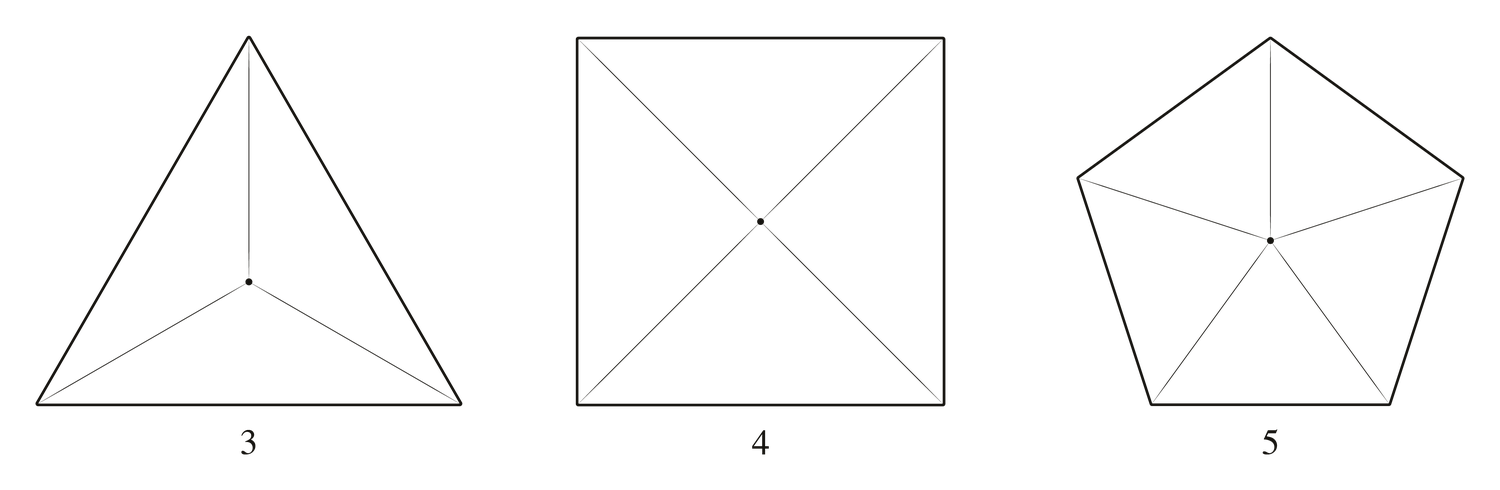
A regular polygon is a 2-dimensional n-sided shape in which the sides are all the same length and are symmetrically placed about a common center, i.e., the polygon is both equiangular and equilateral. The terms equilateral triangle and square refer to the regular 3- and 4-polygons. Pentagons are regular 5-polygons, third in an infinite series of perfect polygonal shapes in 2-dimensions that approximate to a circle at infinity (Fig.1).
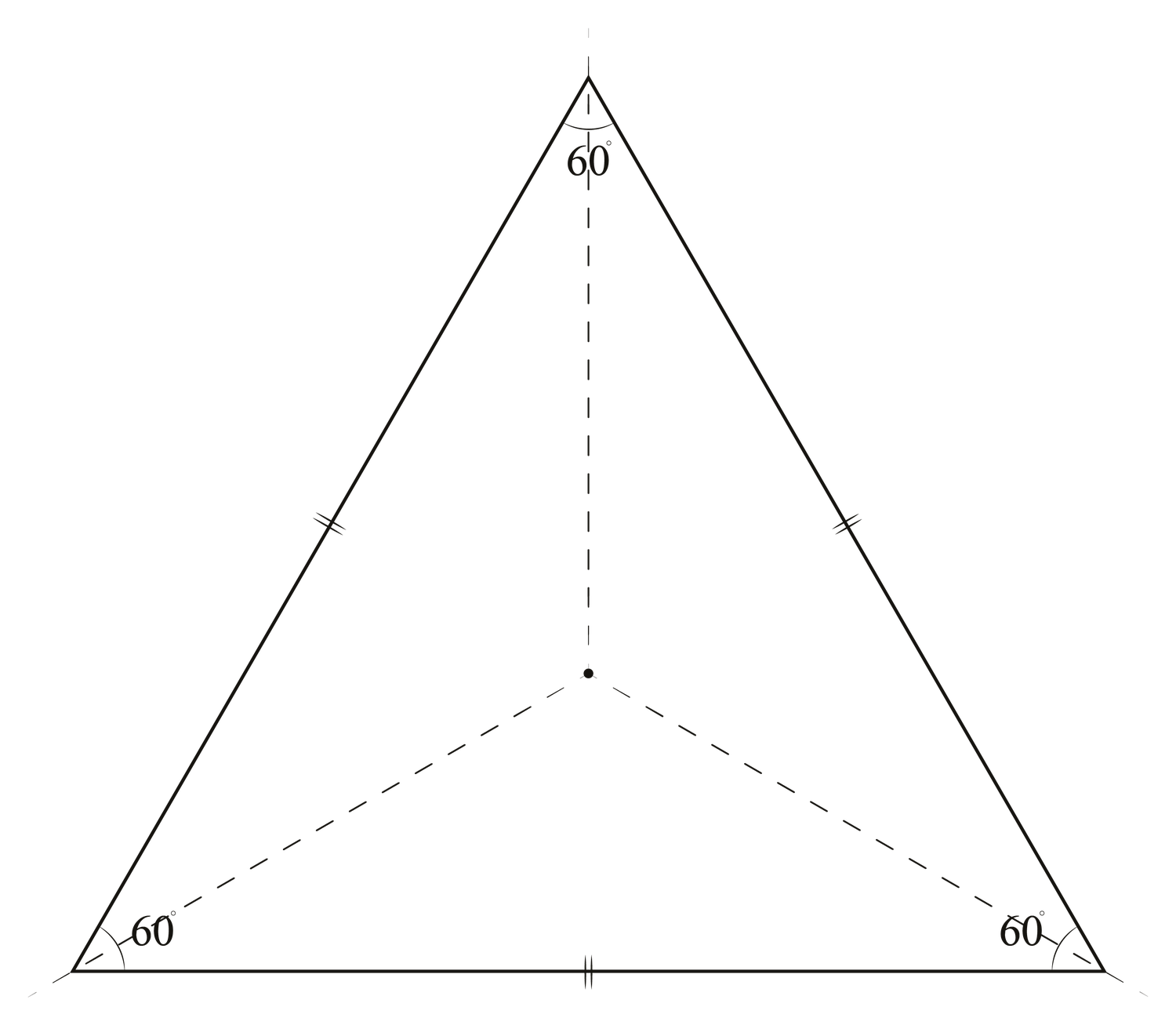
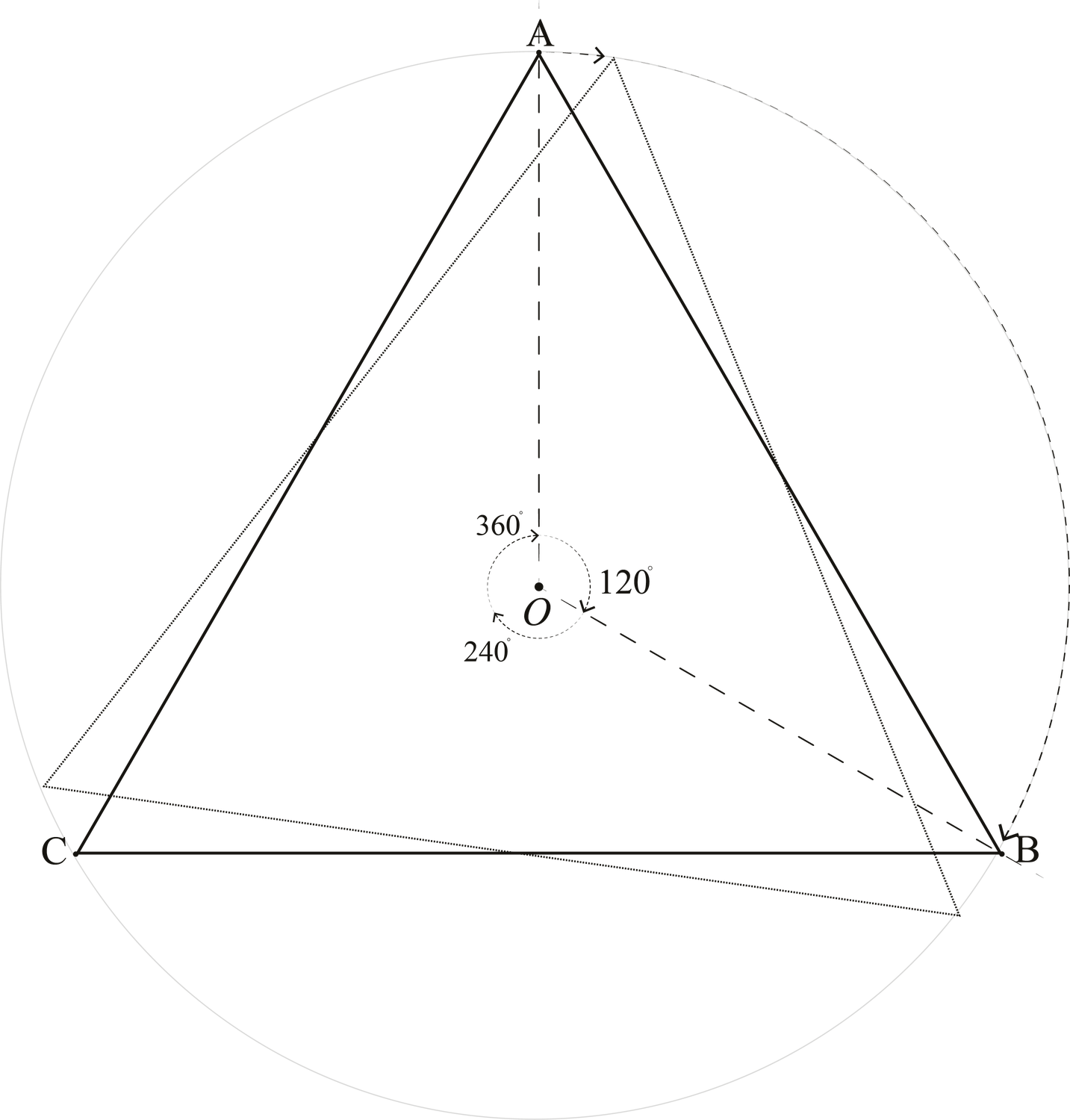
The equilateral triangle or 3-polygon (Fig.2), consists of 3 equal length sides at 60-degree adjacent angles from one-another. These lines meet at 3 vertices, A, B, and C, which are equidistant from center O (Fig.3). The triangle repeats itself with every 120-degree rotation through axis O, creating 3 instances of symmetry through 360-degrees.
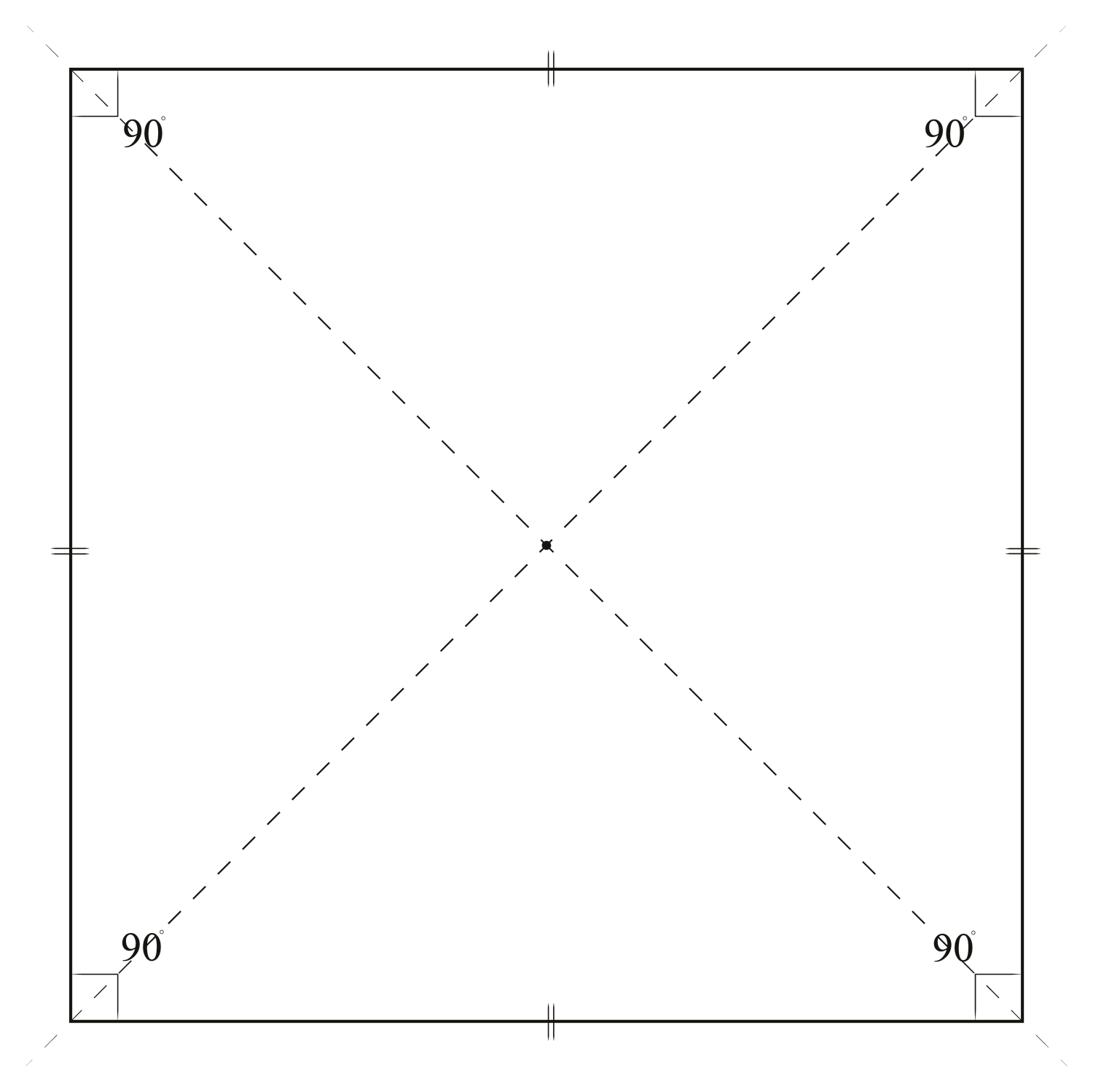
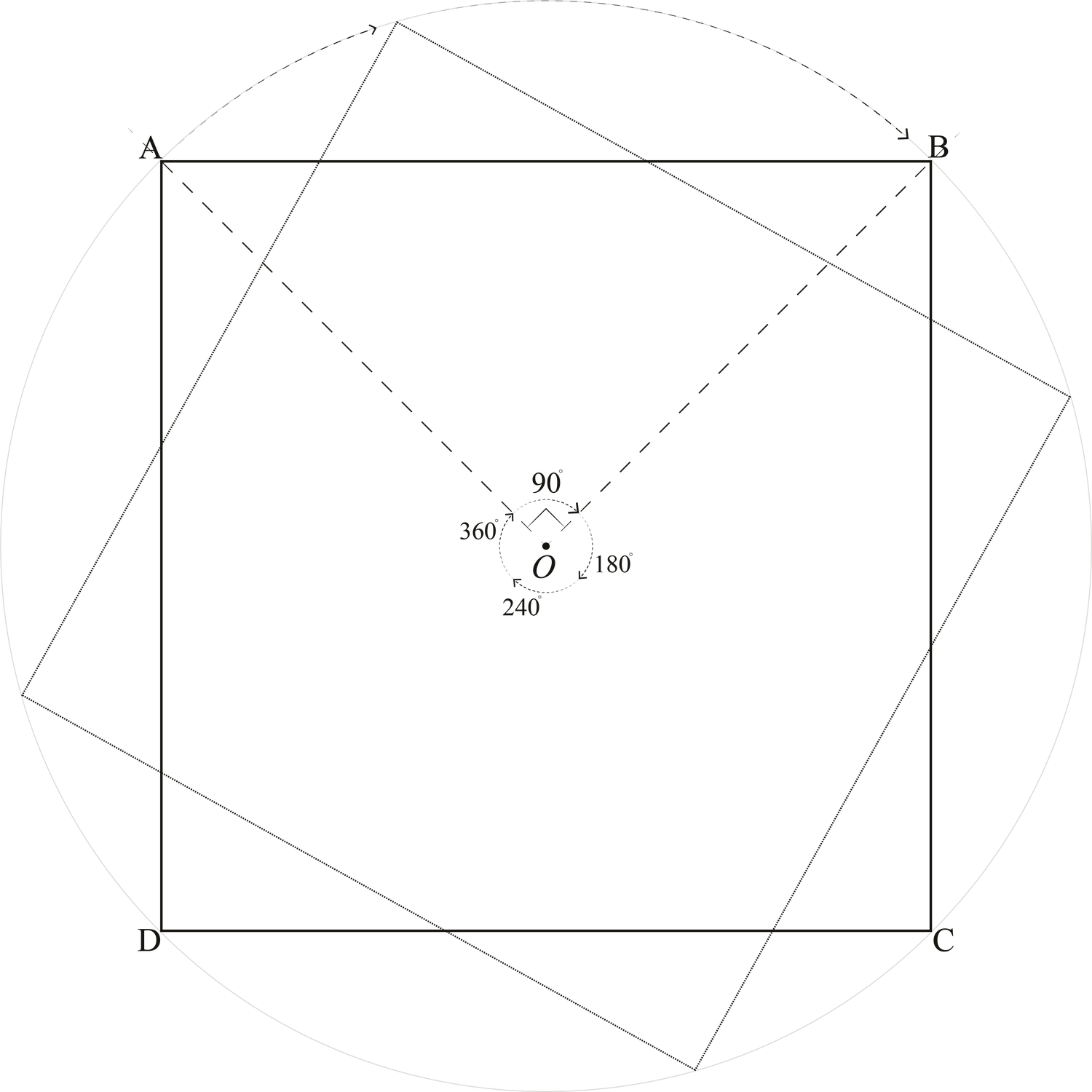
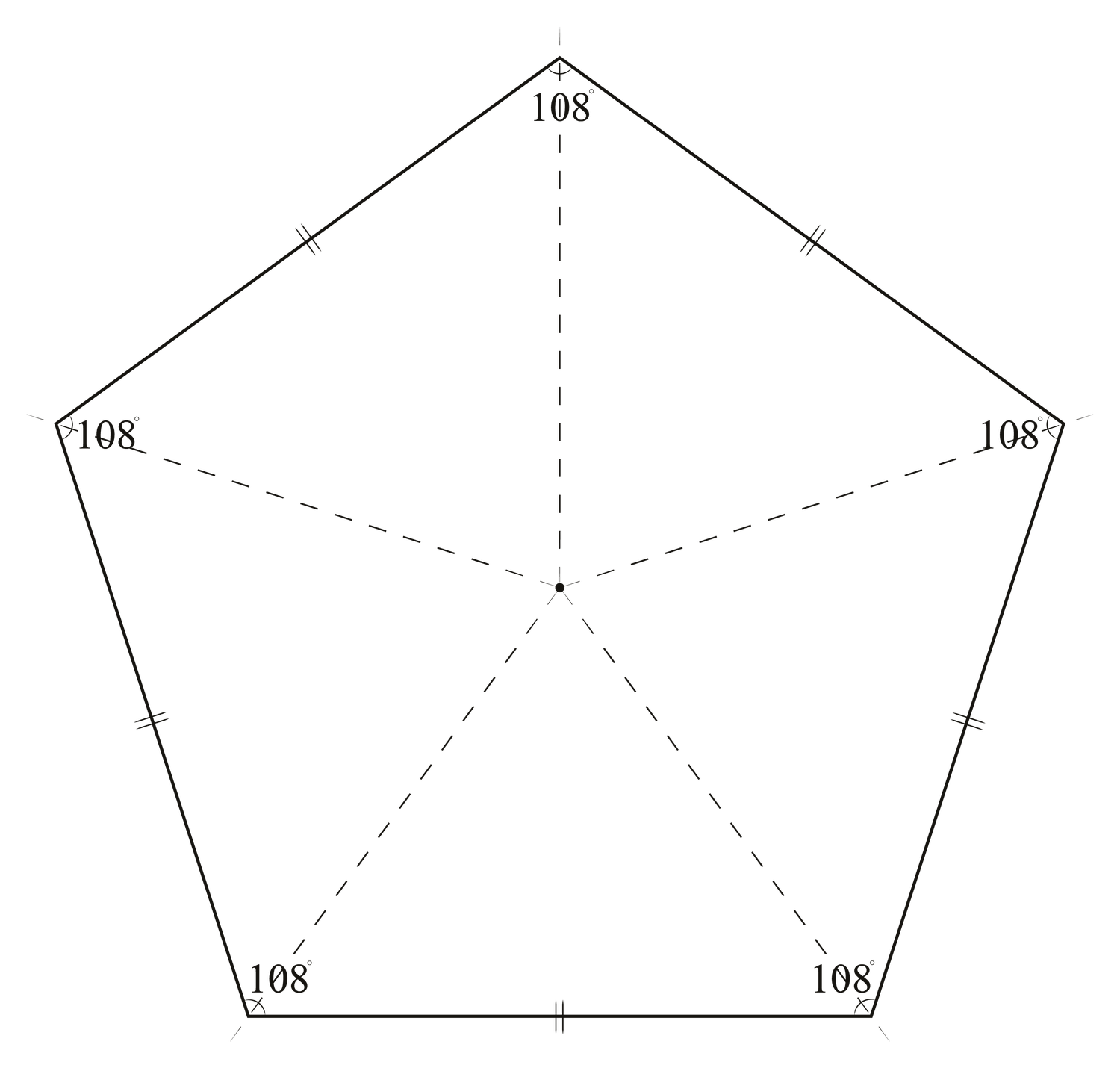
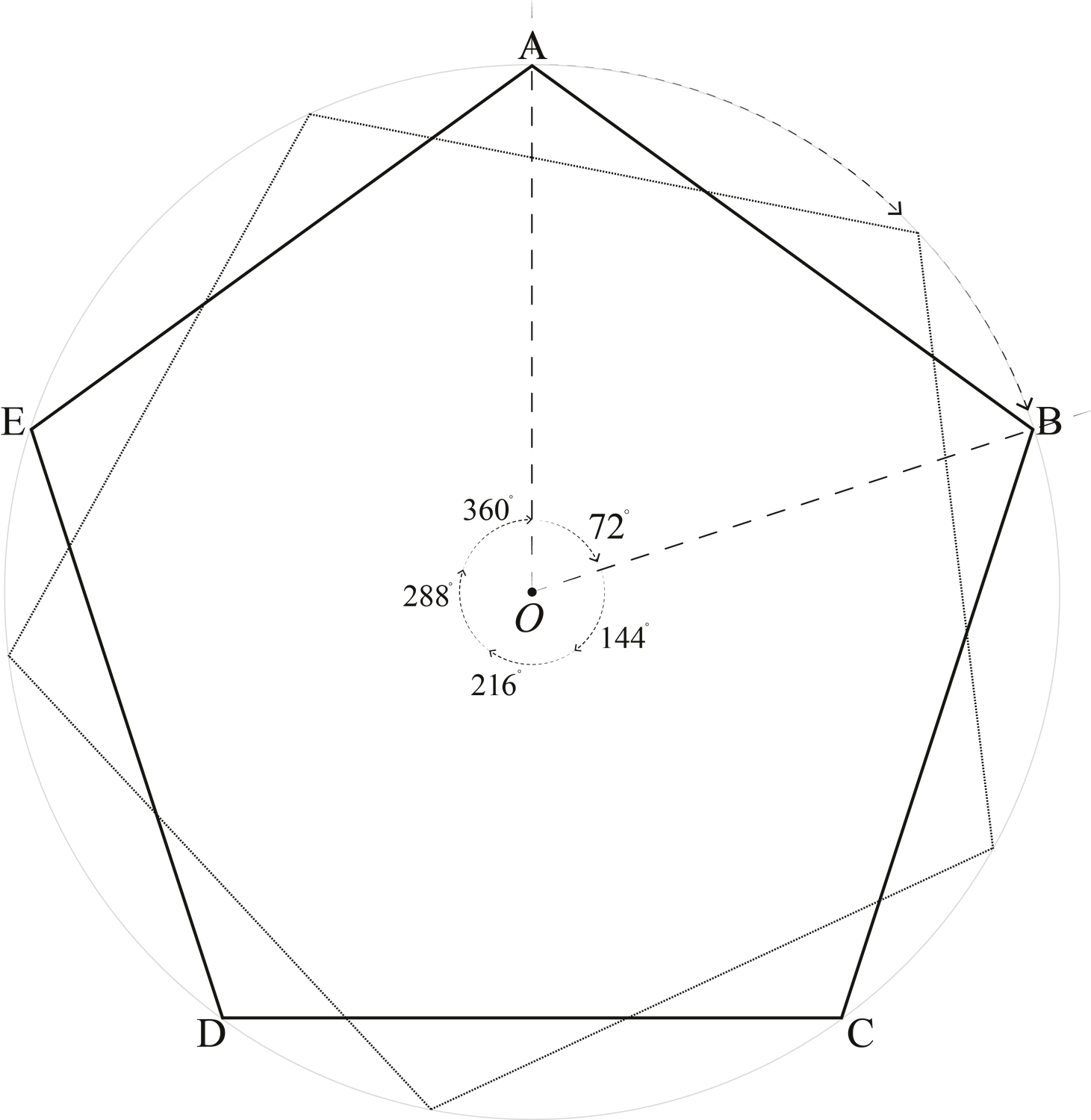
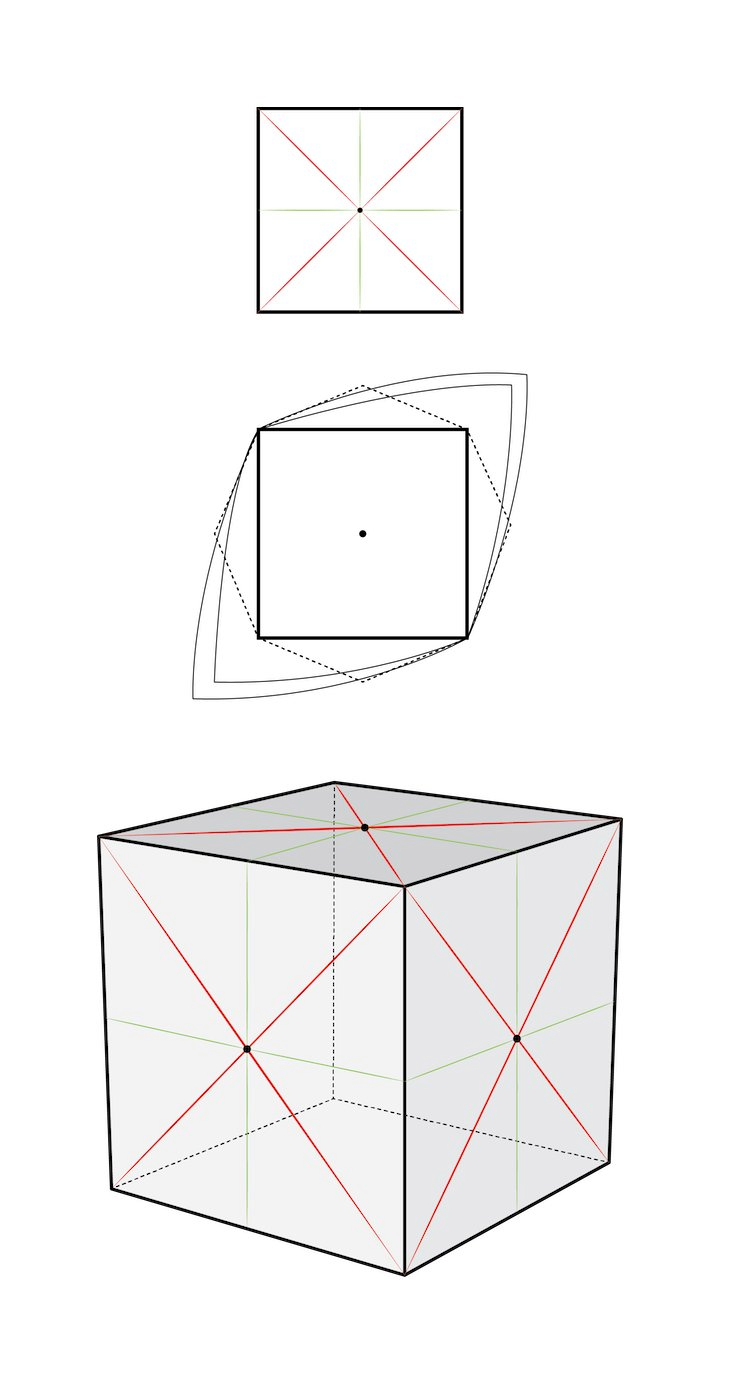
The square or 4-polygon (Fig.4) has 4 equal length sides at a 90-degree right angle from one-another, and the pentagon or 5-polygon (Fig.6) has 108-degree angles between 5 equal length sides. Squares have 4 vertices, A, B, C, and D (Fig.5), and pentagons have 5 vertices, A, B, C, D, and E (Fig.7) — that are each equidistant from center O. Squares repeat with every 90-degree rotation pivoted at O, having 4 instances of symmetry in 360-degrees. A pentagon requires 72-degree rotations for 5 symmetric repetitions through 360-degrees.
Hence the equilateral triangle exhibits 3-fold symmetry, while squares and pentagons exhibit 4- and 5-fold symmetry, respectively.

ii. Regular tessellations
A tessellation is a pattern of shapes repeated to fill a plane or space. These can be a tiling of polygons (2-dimensional), polyhedra (3-dimensional), or polytopes (n-dimensional).
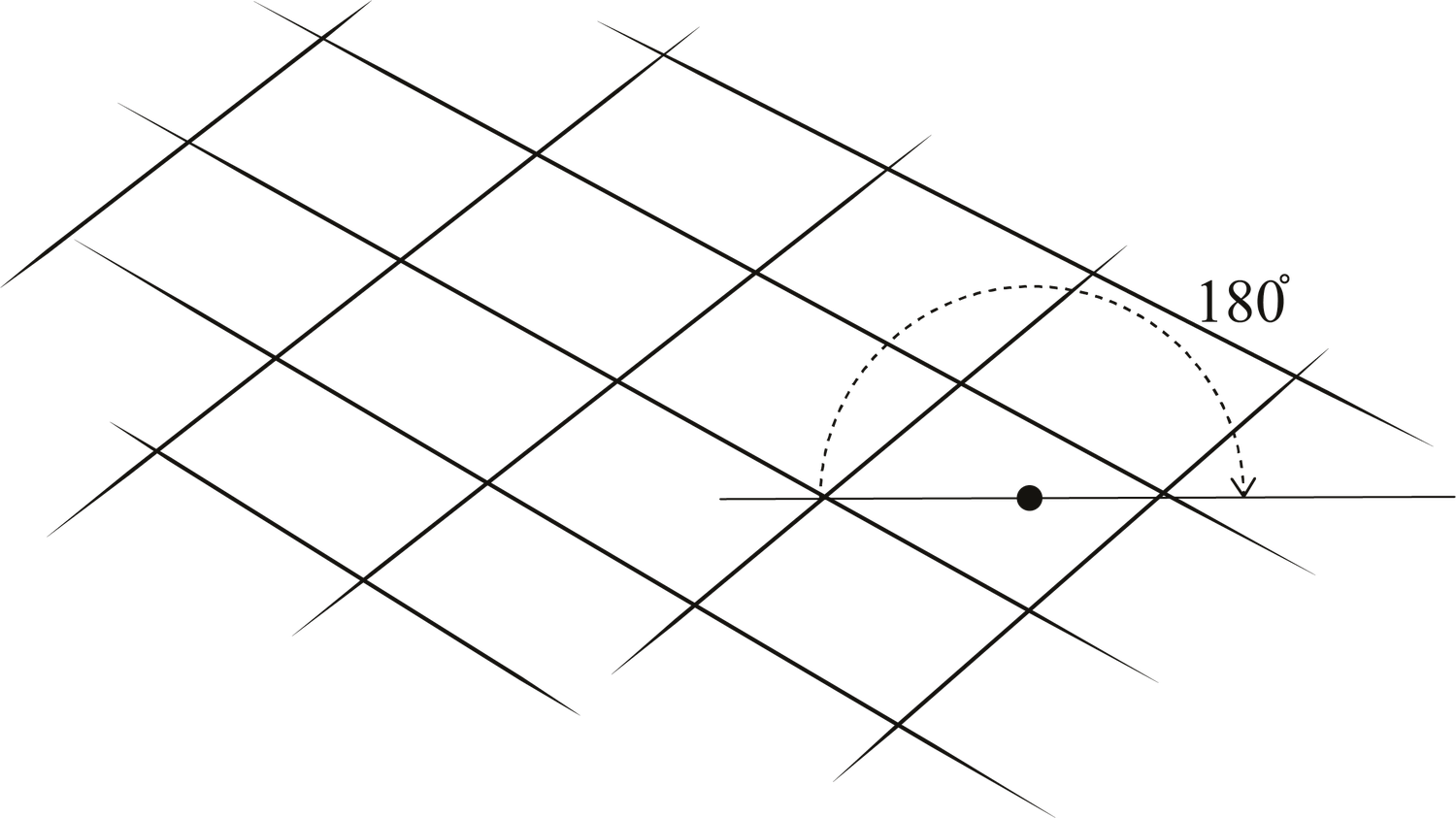
In 2-dimensions, the breaking up of self-intersecting polygons into simple polygons is also called a tessellation, or more properly, a polygon tessellation. The shapes do not overlap and there are no gaps. For a tessellation made of polygons, the sum of angles formed at any vertex is 360 degrees. For example, a congruent polygon tessellation is made of parallelograms (2-fold, Fig.8), which repeats at 180 degrees of rotation.
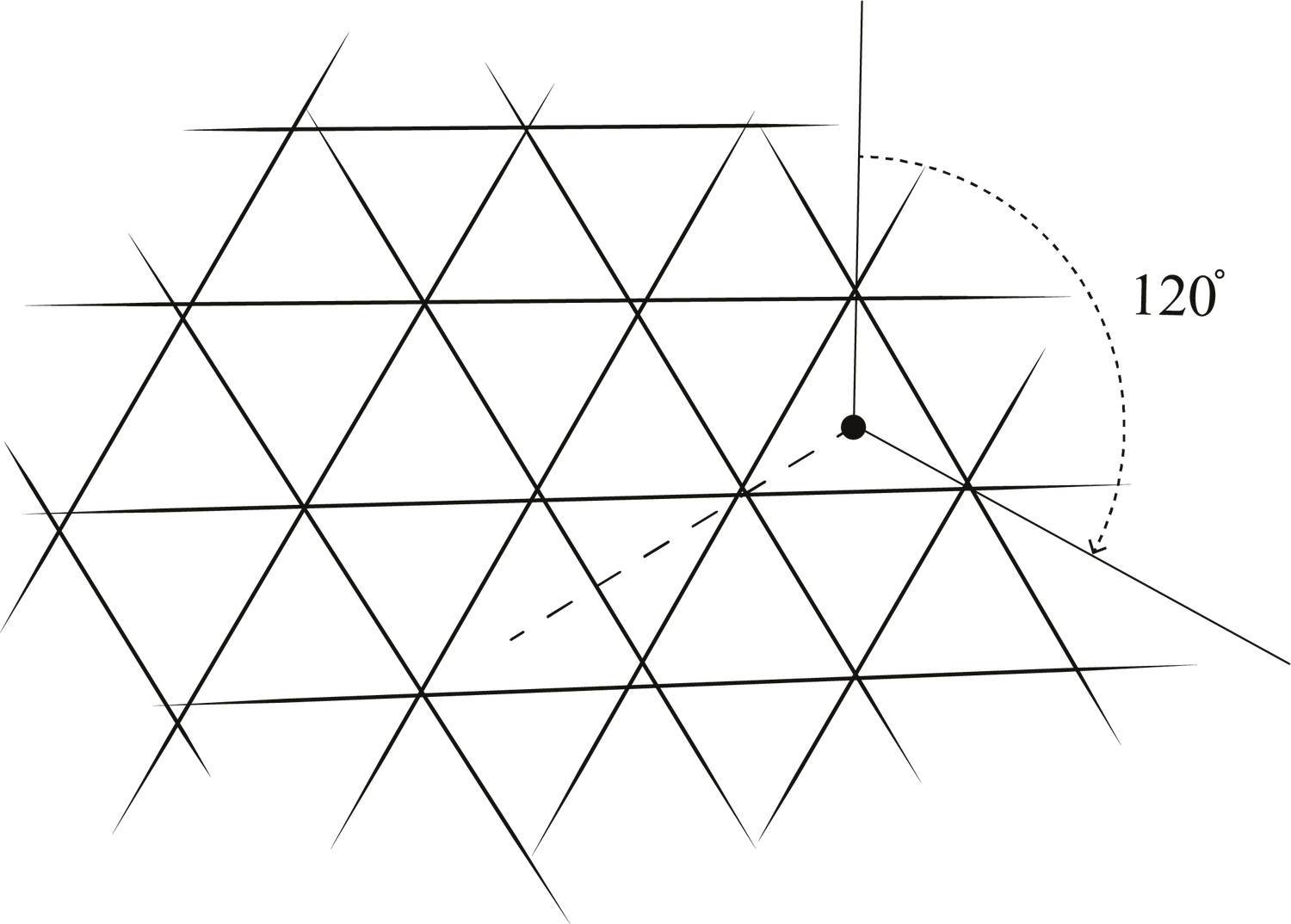
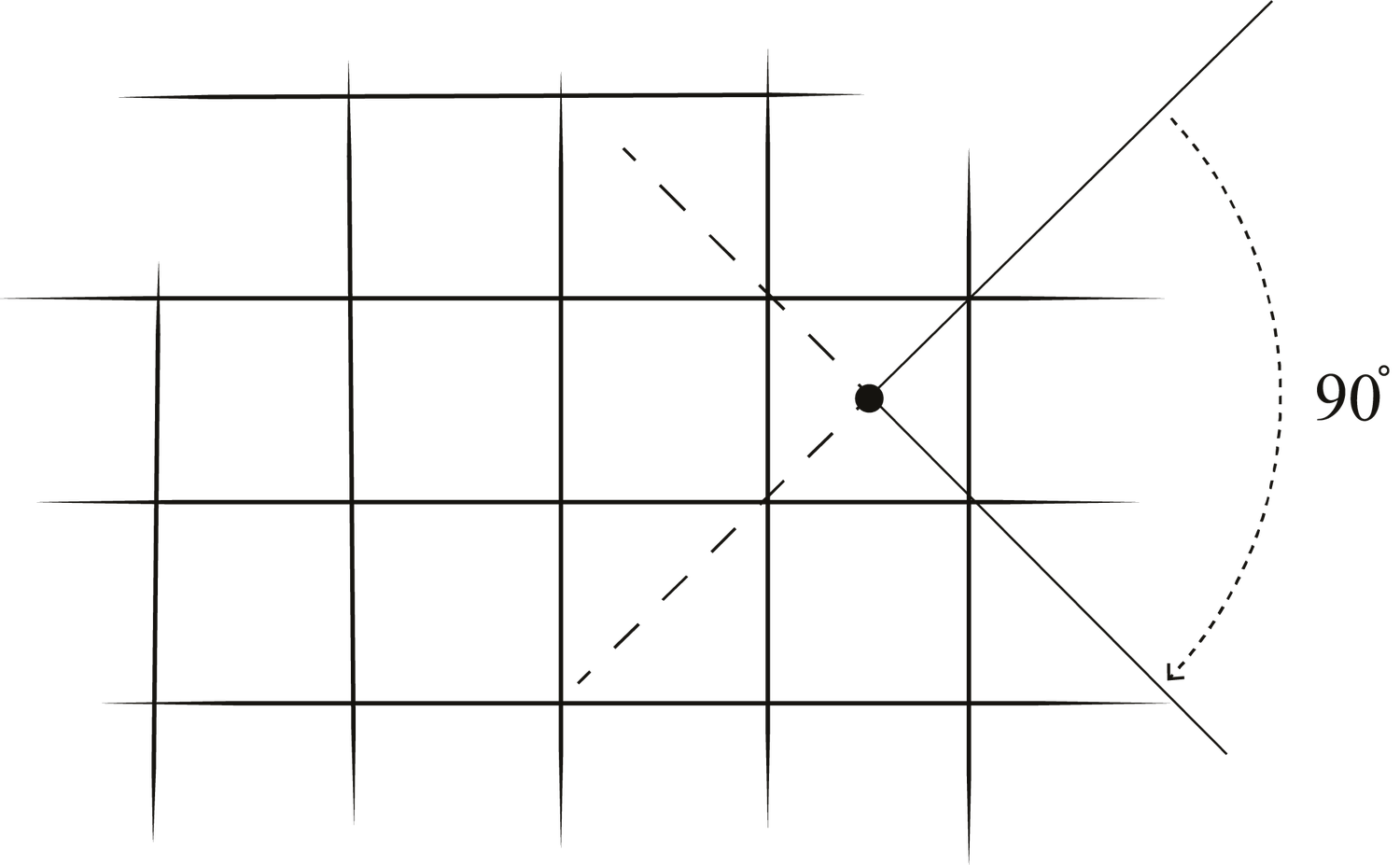
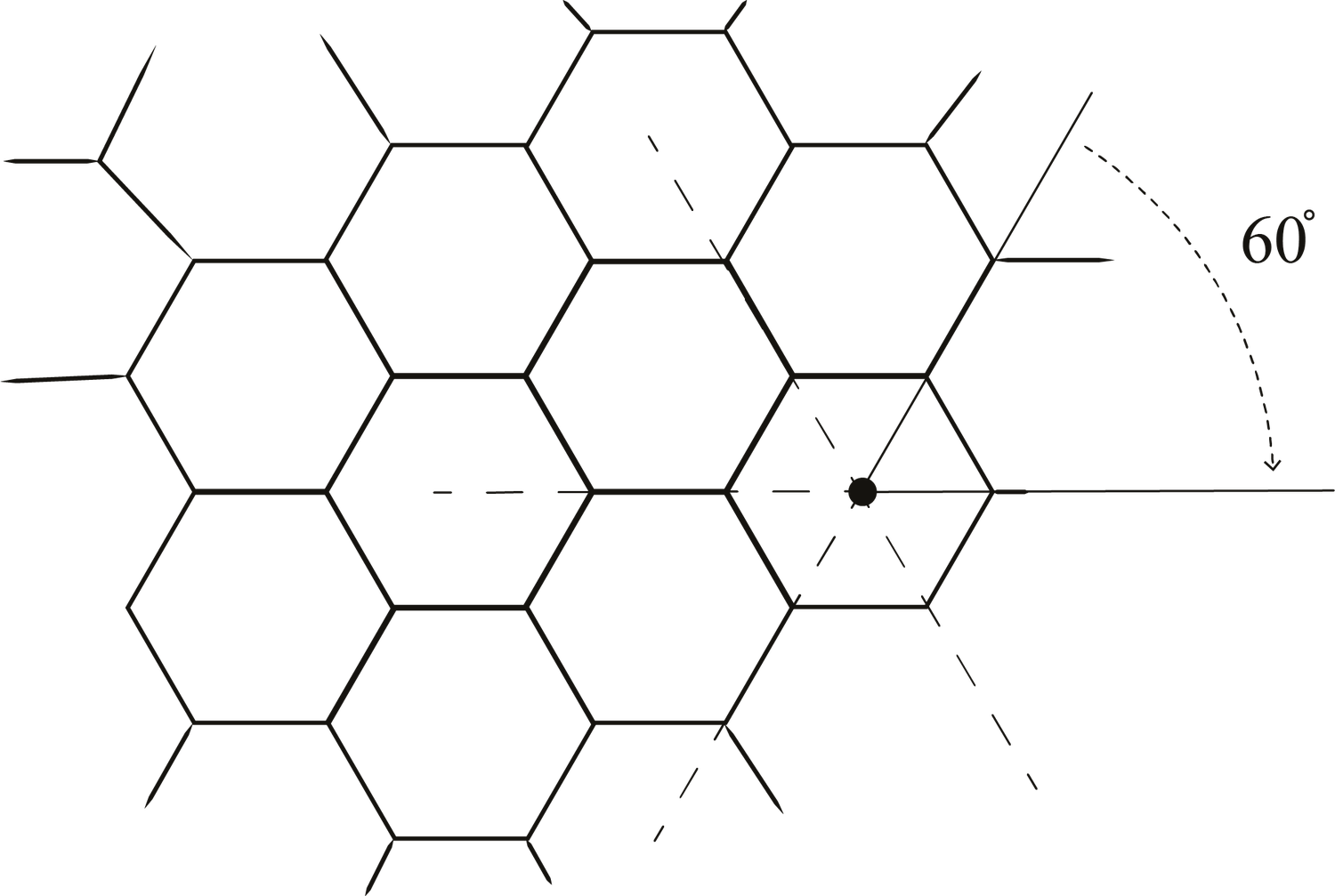
A regular tessellation is made up of only one type of regular polygon. They are highly symmetric edge to edge tilings that can theoretically fill a plane to infinity. There are only 3 tessellations that are composed entirely of regular polygons, those made of equilateral triangles (3-fold, Fig.9), squares (4-fold, Fig.10), and hexagons (6-fold, Fig.11). Each of them have rotational-translational symmetry. The 3-fold tessellation repeats at 120 degrees of rotation, the 4-fold at 90 degrees, and the 6-fold at 60 degrees.
In 3-dimensions, a polyhedron which is capable of tessellating space is called a space-filling polyhedron. Examples include the cube, rhombic dodecahedron, and truncated octahedron. A tessellation of n-dimensional polytopes is called a honeycomb lattice.
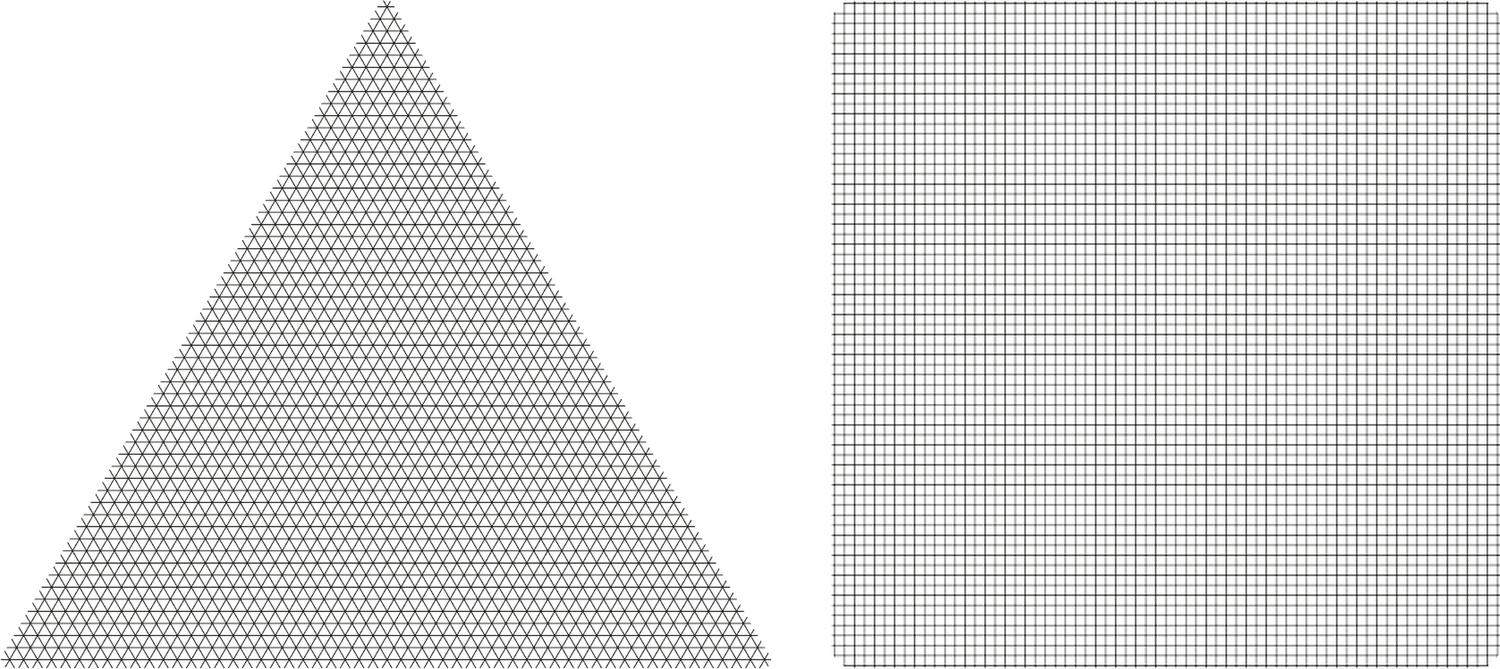
When a polygon structure and superimposed tessellation are constructed with the same n-fold symmetry, they create self-similar modules. Seen below (Fig.12) are wireframe self-similar 3- and 4-fold modules.
When dipolygons (2 overlapping layers of identical regular polygons) are considered in the construction of platonic dipolygonids, checkered (black and transparent) tessellations create a relevant superimposition for self-similarity (Fig.13, Fig.14). As these alternately checkered grids perfectly overlap, the structure becomes opaque, because the transparent polygons of the top layer grid overlap with the black polygons on the bottom layer grid.
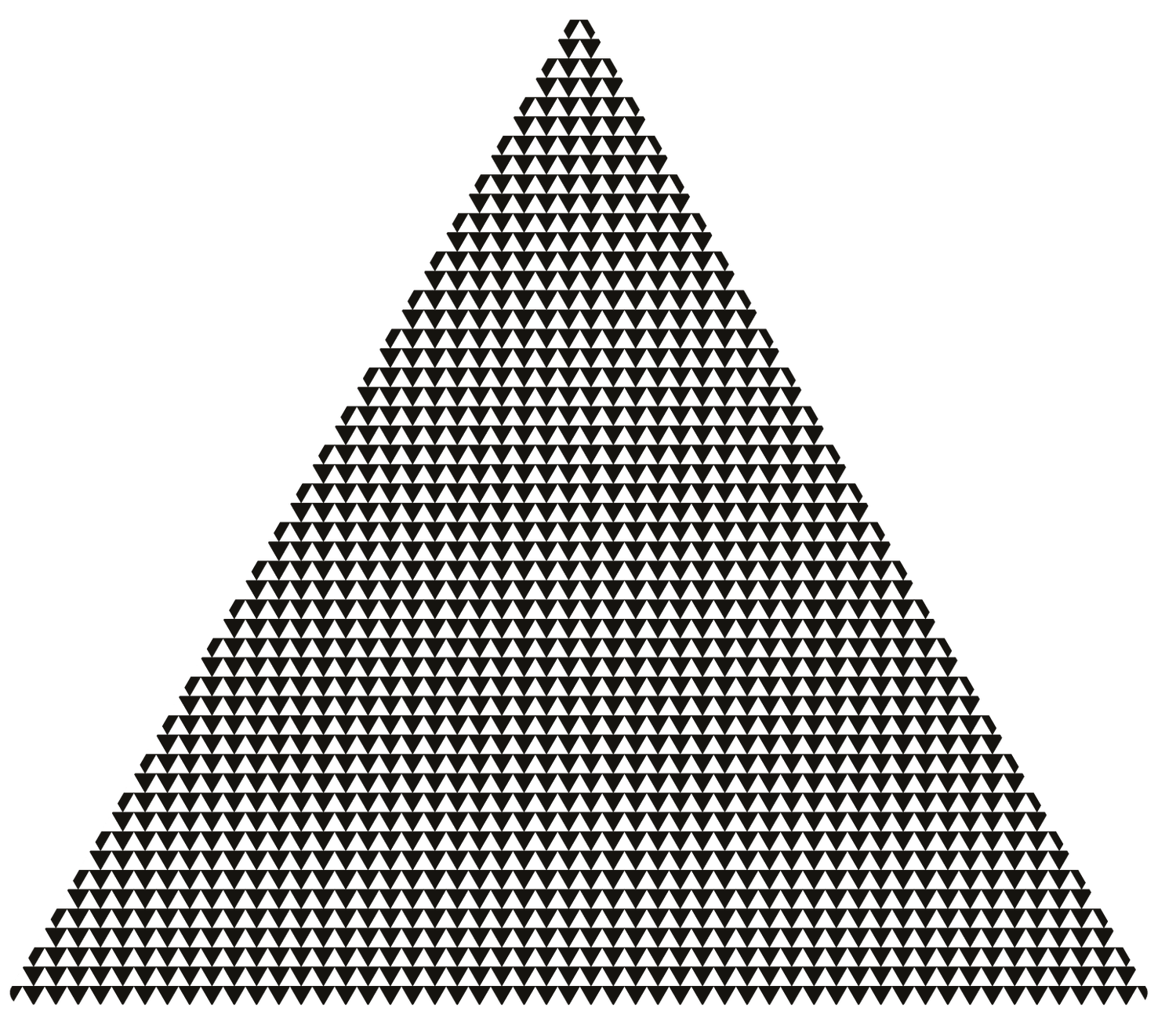
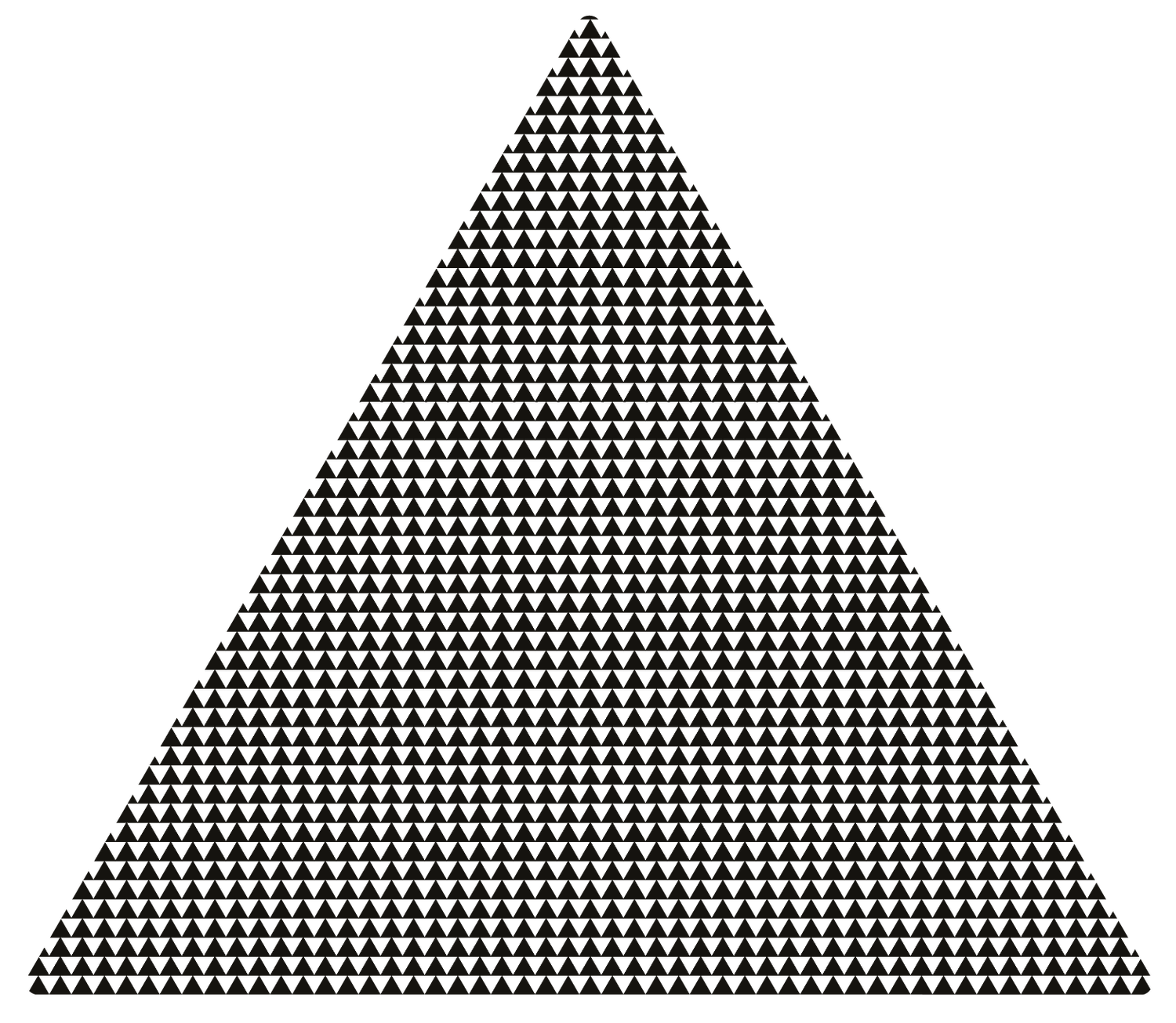


Parallelograms and hexagons do not make any regular 3-dimensional solid. So we shall consider only equilateral triangle and square tessellations for the construction of Platonic dipolygonids. This is because in terms of regularity, only 3-fold and 4-fold tessellations create appropriate superimpositions for a self-similar module.
iii. Quasi-periodic tessellations
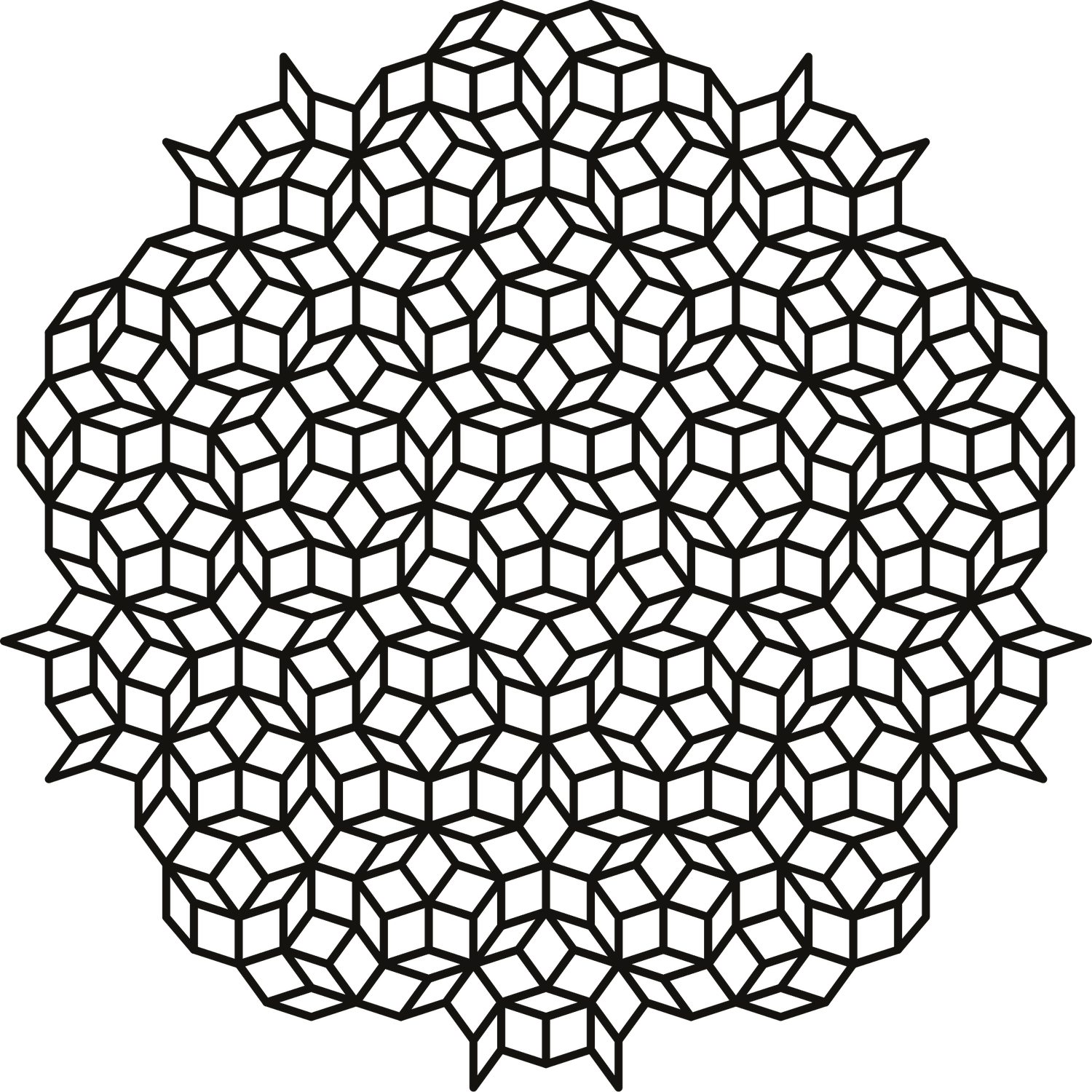
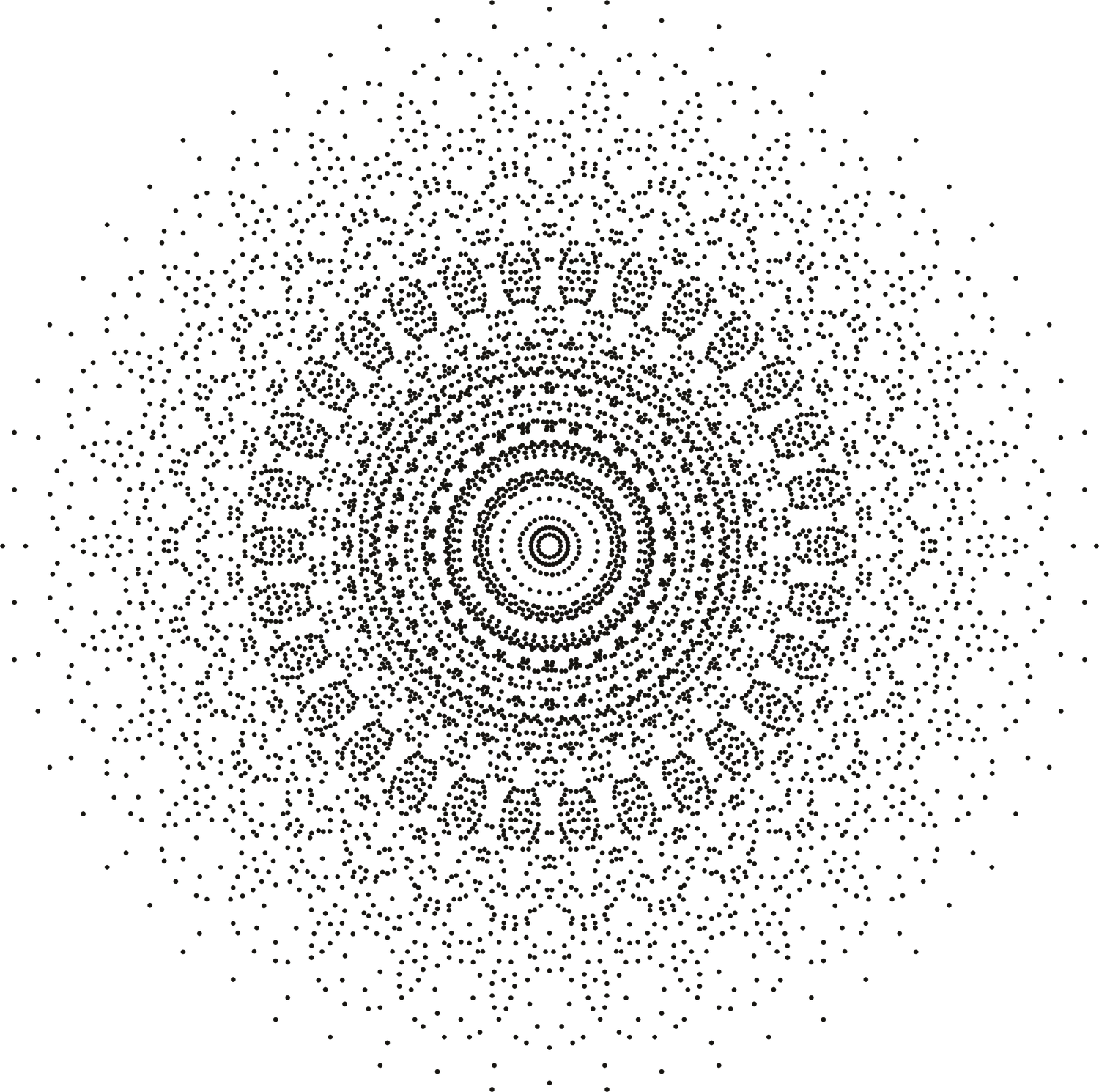
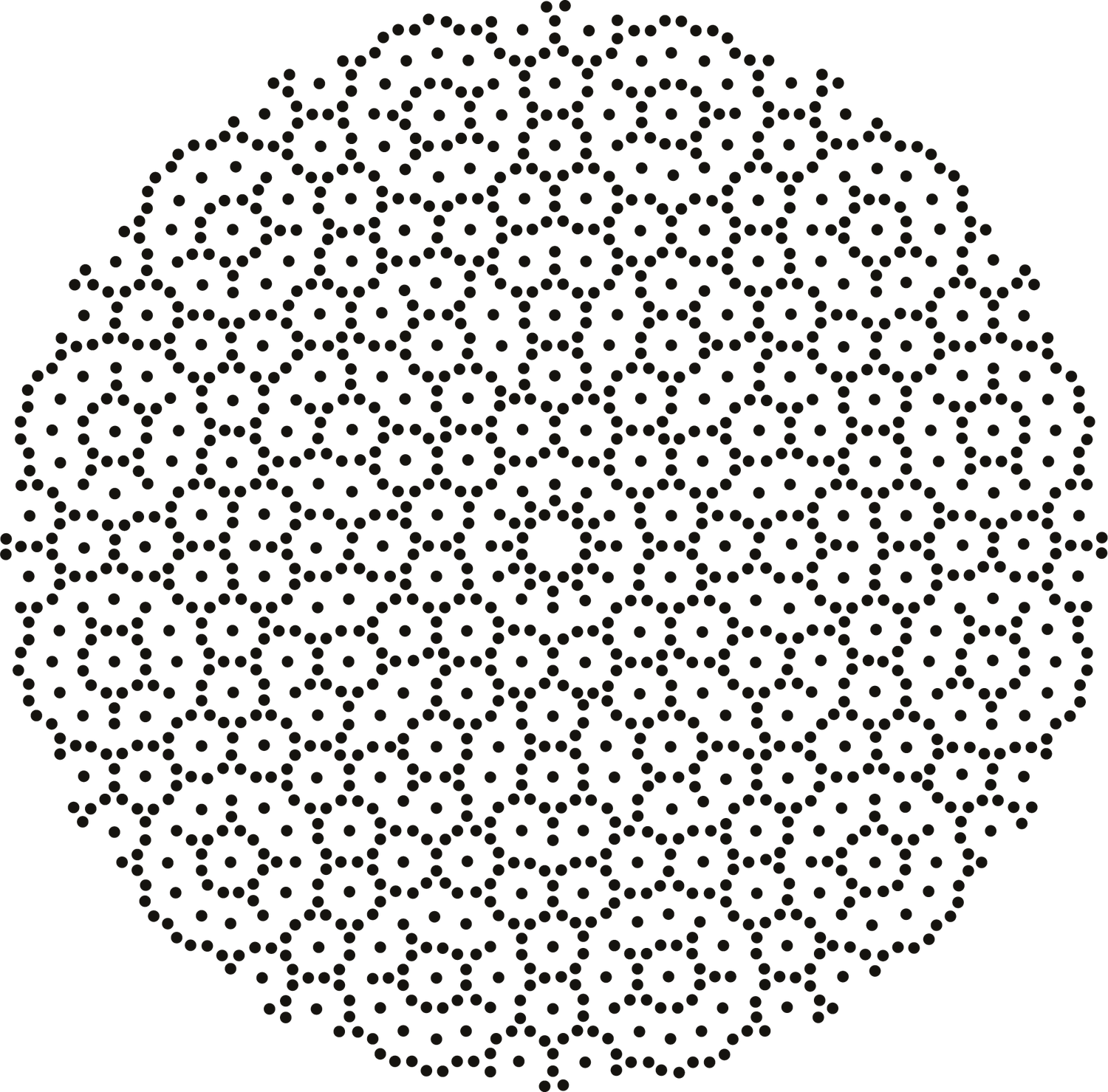
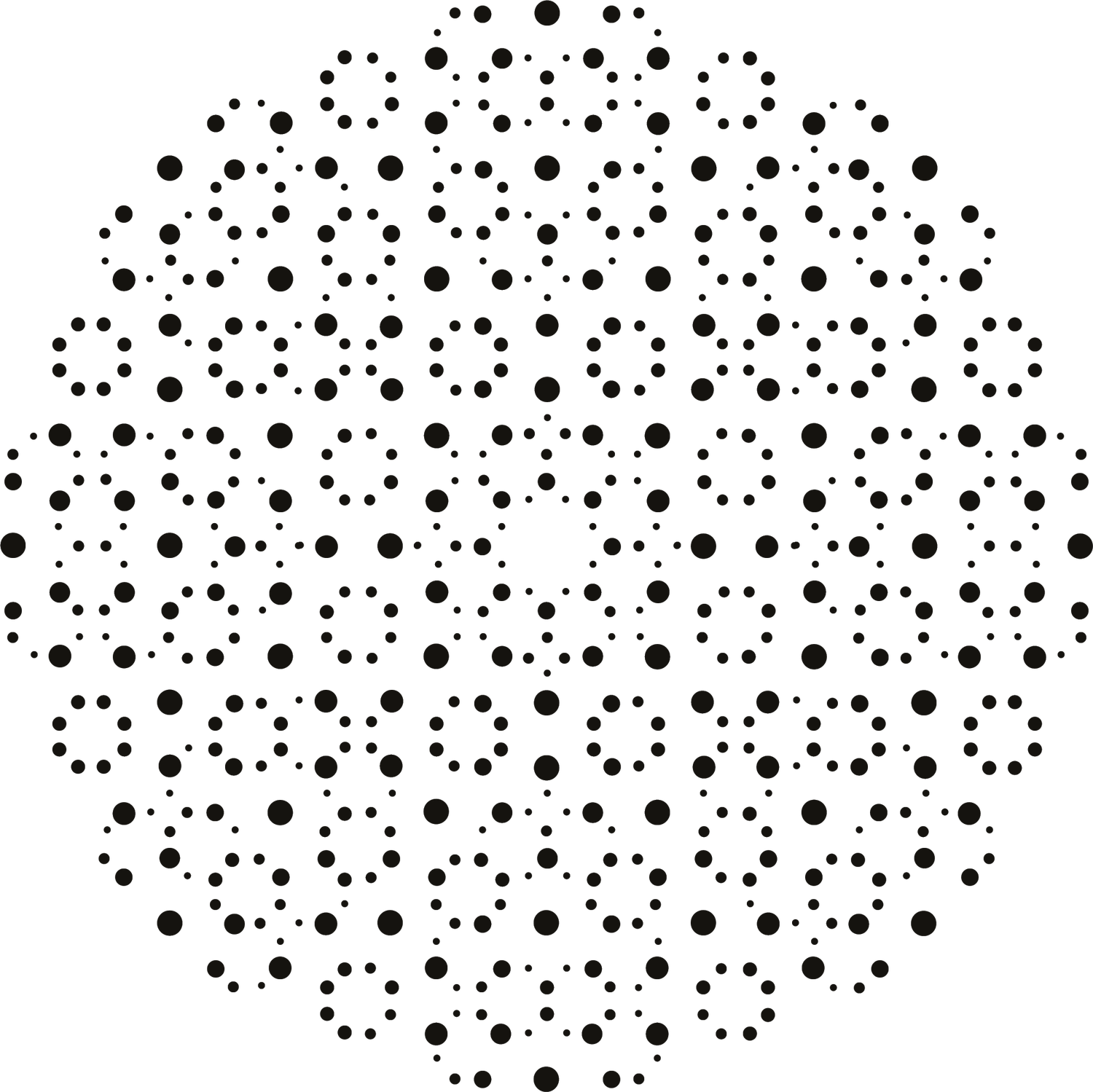
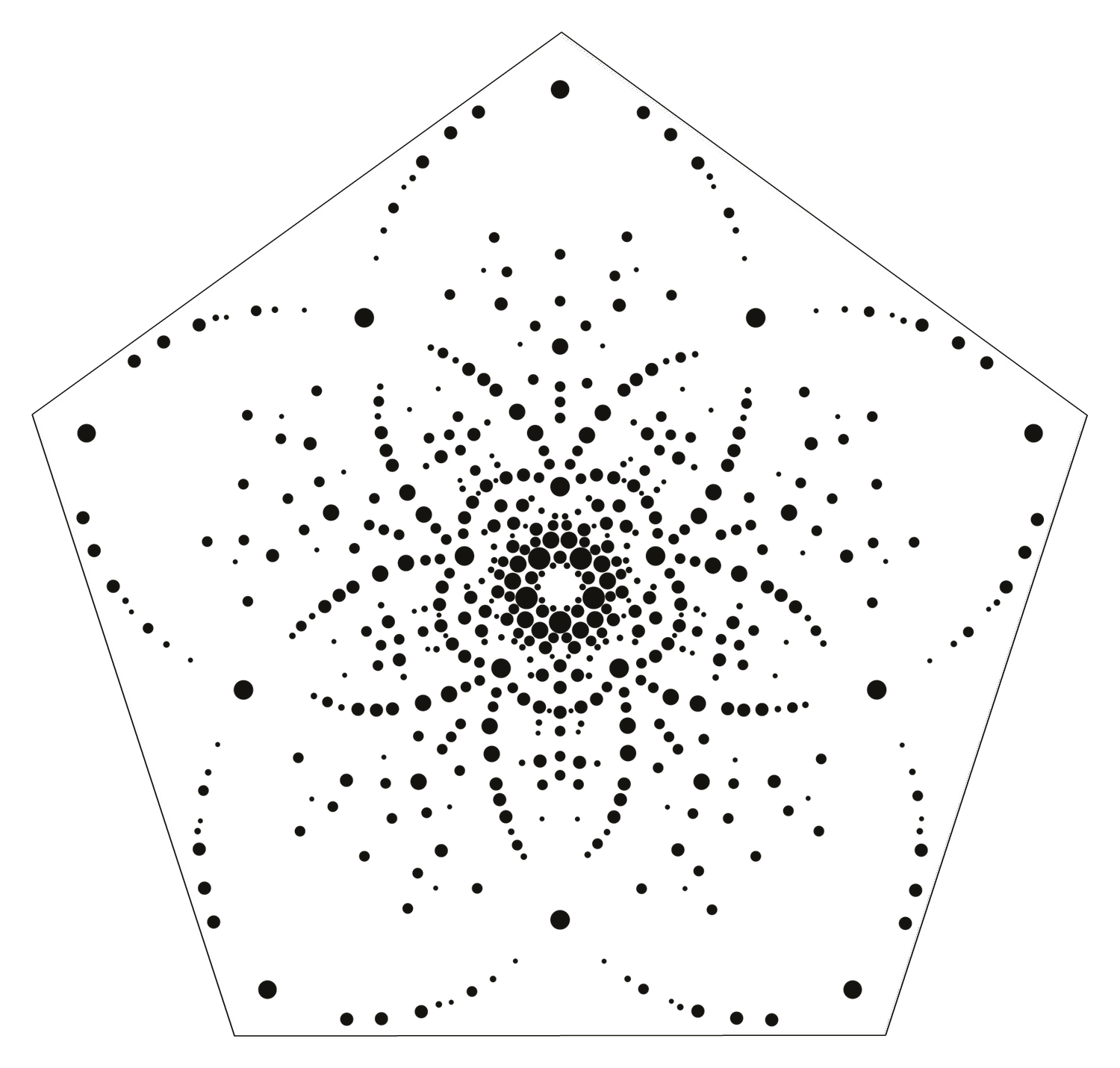
The discovery of quasicrystals (Fig.15) by Dan Shechtman in 1982 led to a redefinition of symmetries to include quasi-periodic 5-fold symmetry (as well as 8, 10 and 12-fold), to the existing 2-, 3-, 4- and 6-fold symmetry system of crystallography as exhibited in natural crystals. Previously in the 1960’s, Roger Penrose created aperiodic tilings now known as Penrose tilings (Fig.16), which had quasicrystalline symmetry. Shechtman’s discovery was the first instance of them being found in nature.
They are termed ‘quasi’ because their molecular arrangements are ordered but not periodic, in the sense you can continuously fill all available space using the pattern, but the atomic lattice lacks translational symmetry. This means a shifted copy will never match the original, or that they exhibit incommensurability along any given direction. They cannot be periodically tiled, for instance, the way a square grid or cubic lattice can. In theory they can be viewed as irrational 3-dimensional slices of hyper-cubic 5-dimensional or higher dimensional periodic lattices (the cut set at an irrational slope fixed by the golden ratio, ~1.618), that are then projected with an icosahedral perspective onto 2 dimensions to create quasi-periodic dot arrangements (Fig.17, Fig.18).
These provide 5-fold pentagonal symmetry with which we can create a rotation-translation interference pattern while staying true to the 5-fold symmetry of the dodecahedron, thus allowing for self-similar dodecahedral dipolygonids.

IIISelf-similar 2-dimensional moiré patterns
i. Regular interferences
An interference pattern occurs when two waves superpose to form a resultant wave of greater, lower, or the same amplitude. It can be visually created by overlapping grids (lattices) or dot arrangements, and is produced when an opaque regular pattern with transparent gaps is overlaid on another similar pattern. These appear only when the patterns are rotated by a small twist angle relative to each other or have different, but similar pitches.
Moiré emerges from the superimposition and slight miss registration of two or more patterns. A classic moiré is composed of two sets of parallel lines that are at a slight angle, but moiré patterns can also develop out of grids or dot arrays, curved lines, and innumerable other arrangements. Jennifer L. Roberts states that the key quality of a moiré pattern is that it emerges in a nonlinear way from its component structures. It does not exist in either individual pattern but is generated only in their combination. Depending on the mutual angles, frequencies, and periodicities of the two elements, moiré can crop up in a lot of different places. It explores an intersubjective neurological space, a space of intermediation. Yet it is an objective phenomenon as it operates in the oral register as well, through cymatic patterns and beat phenomenon. Frequencies of sound can generate moiré beats as the sound is unfolding.
Moiré patterns create a tension between bottom-up or physical signals, and top-down or cognitive signals. The interference of these lines, grids, and dots that the brain or a machine registers, adds up adjacent areas in the retina to create the illusory optical pattern. It is a self-generated illusion who’s mechanisms of creation are absolutely obvious, as there’s no sleeves, smoke, or mirrors.
A regular moiré pattern consists of an n-fold dipolygon, identical n-fold tessellations, and a resulting n-fold interference i.e, all components are self-similar, made of only one type of regular polygon. For example, a wireframe 3-fold tessellation superimposed on an equilateral triangle (with 120 degree rotational symmetry) — rotated against an identical grid about a common center — will produce an interference of telescoping equilateral triangles with a periodicity or angle of symmetry of 120 degrees (Fig.19). The same is true for the wireframe 4-fold tessellation and square dipolygon (with 90 degree rotational symmetry), from which a square moiré pattern emerges with a periodicity of 90 degrees (Fig.20).
ii. Checkered interferences
If the 3-fold dipolygon tessellation consists of alternately checkered (black and transparent) triangles instead of wireframes, a subtler interference appears. Its periodicity is 120 degrees, and the cycle breathes twice within it. At exact register the two phases interlock as perfect complements and the dipolygon is opaque; as the layers turn, white channels crack open through the black field and a telescoping 3-fold moiré of nested triangles contracts toward the half-period. At 60 degrees the counter-rotated layer arrives with its triangles re-oriented to match the first, and the pair closes into a second, offset register — from which the sequence opens again in the negative, black walls bounding white triangles where white walls had run through black. What goes in through the contracting sub-period comes back out as its colour-dual (Fig.21).
When the 4-fold dipolygon tessellation consists of alternately checkered (black and transparent) squares instead of a wireframe grid, the interference keeps a 90 degree periodicity, and here the cycle breathes only once: opaque at register, a self-similar 4-fold moiré of telescoping and magnifying squares — turned 45 degrees from the original grid — opens, contracts past the half-period, and closes back to opacity. No second register interrupts the cycle, because a 45 degree turn carries the square lattice onto none of its own directions, whereas the triangular lattice at its half-period lands back on its own directions with the two colours exchanged (Fig.22).
Which periodicity, and which internal structure, a checkered pair exhibits is therefore governed by several factors acting together: where the shared center of rotation falls on the tessellation — on a vertex or inside a face — which the odd or even count of the grids decides; whether the grids are wireframe, blind to the two-colouring, or checkered and bound to it; and how the rotations that exchange the two colours sit against the directions of the lattice itself. A systematic account of these interactions, geometric and algebraic, remains an open thread of this inquiry.
Identically checkered 3-fold grids create a 3-fold moiré with periodicity of 120 degrees. Initially one sees a telescoping pattern of white triangles with black grids. This inverts at 30 degrees to black triangles with white grids for a 60-degree sub-period — then reverts to the original pattern to complete the 120 degree cycle. Adding alternately checkered grids to the 3-fold dipolygons changes the interference altogether: a 4-fold moiré appears, and the cycle stretches to a full 360 degrees — the mark of a pivot about which no smaller turn restores the colouring, such as an edge midpoint. How that 4-fold interference arises from 3-fold grids remains unexplained; Section VI meets it again on the octahedral transformer. Identically and alternately checkered 4-fold grids pivoted on a lattice vertex, where four squares meet and a quarter turn exchanges black and transparent, create a 4-fold moiré perpendicular to the original grids with a periodicity of 180 degrees — twice the 90 degree cycle of the face-pivoted pair of Fig.22. Hence colouring in the tiles, and the point about which they turn, change the algebraic relationships between interacting lines and shapes in 2-dimensional moiré patterns.
Regular interferences have duality embedded in their motion. In each 2-dimensional moiré we have observed so far, the pattern inverts or mirrors after a half cycle of its periodicity.
There is also a fractal-like nature to the dipolygons and the telescoping ghost patterns, in their nested quality. This arises from the equivalent rotation-translation periods of the two regular n-polygons and their n-fold tessellations i.e, in each pattern the structure, grid, and moiré all obey the same n-fold symmetry, with the rotation cycle — R1, of the structure, and nested rotational period — R2, of the moiré being synchronous.
iii. Quasi-interference patterns
The interference patterns of quasicrystals have circular symmetries embedded in their motion. These zoom radially inward and outward. There are 5 rotational-translational symmetries in the overall structural motion of the pentagonal dipolygon through 360 degrees. A self-similar 5-fold Penrose tiling and its resulting interference has 72 degree periodicity (Fig.23) whereas 10-fold quasicrystal interferences have 36 degree periodicity (Fig.24).
IVRegular shapes in 3-dimensions
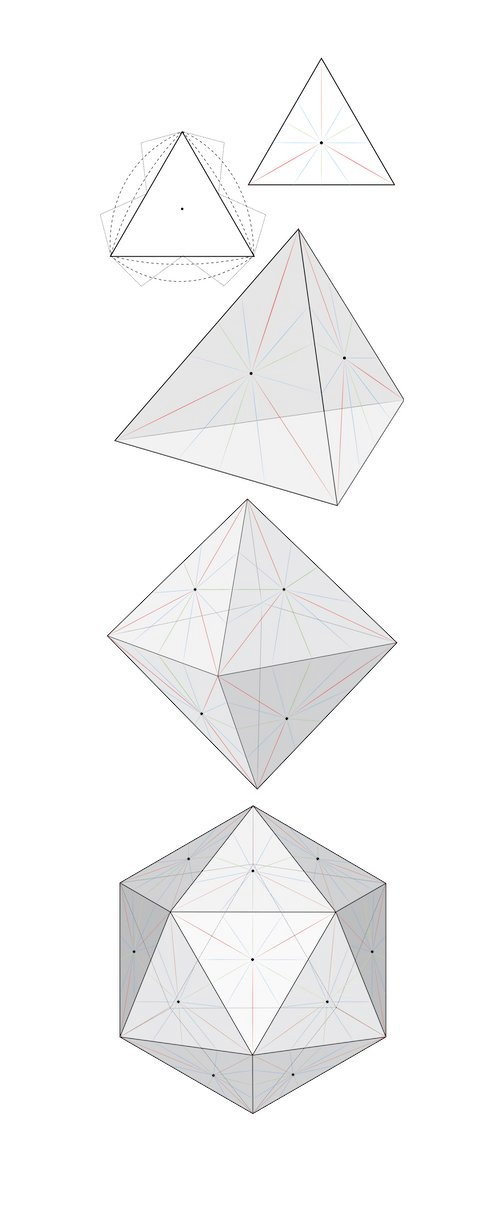
A regular polyhedron is a 3-dimensional shape constructed with congruent (identical in shape and size), regular (all angles and sides equal) polygon faces, where the same number of faces meet at each vertex. Only 3 regular 2-dimensional polygons allow for the construction of regular 3-dimensional polyhedra — the 3-, 4-, and 5-polygon. At least 3 polygon faces meet at each vertex — where the internal angles must add up to less than 360 degrees — or the shape flattens out. There are 5 convex polyhedra that meet this criteria — the tetrahedron, octahedron and icosahedron (consisting of 4, 8, and 20 equilateral triangles respectively), the cube (6 squares), and the dodecahedron (12 pentagons). Collectively, they are the Platonic solids :
Tetrahedron
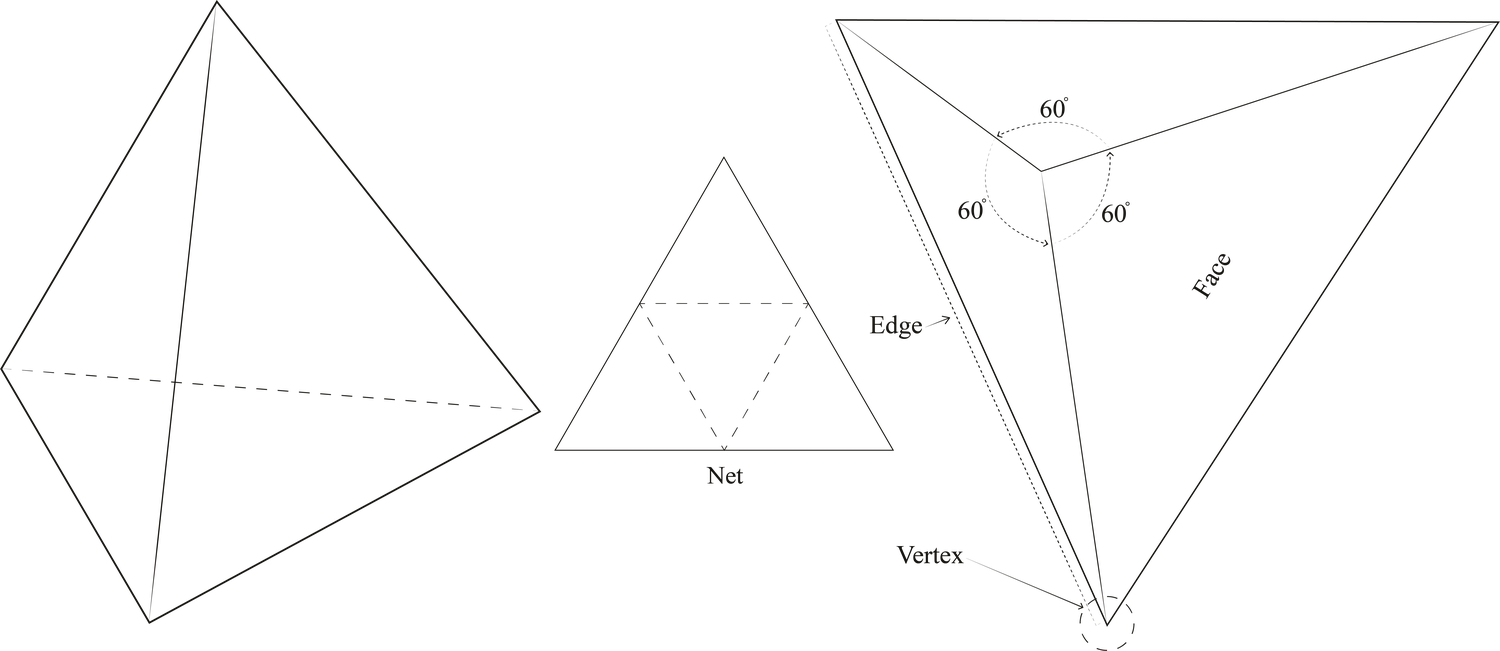
The tetrahedron (Fig.25) or triangular pyramid is the simplest of the five Platonic solids. It consists of 4 equilateral triangle faces, creating 6 straight edges and 4 vertices — all of which are equidistant from each other. 3 triangles meet at each vertex with internal angles of 60 degrees, hence at each vertex the angles sum up to 180 degrees (60x3). It has a dihedral angle (face to face along an edge) of 70.529 degrees. Unlike other platonic solids, a tetrahedron has no parallel faces and it is also dual to itself.
Octahedron
The octahedron (Fig.26) is a polyhedron with 8 equilateral triangle faces, which creates 12 edges, and 6 vertices. 4 equilateral triangles meet at each vertex. The internal angles are 60 degrees, therefore the angles at each vertex sum up to 240 degrees (60x4). The dihedral angles are 109.471 degrees. The dual of the octahedron is the cube.
Icosahedron
The icosahedron (Fig.27) has the most number of faces and the greatest volume for its surface area, of any platonic solid. It is often termed ‘the mathematician’s jewel’ for its beauty and symmetry. It consists of 20 equilateral triangle faces, which create 30 edges and 12 vertices. Since all internal angles are 60 degrees and 5 triangles meet at each vertex, the angles at each vertex sum up to 300 degrees (60x5). The dihedral angles are 138.189685 degrees. The dual of the icosahedron is the dodecahedron.
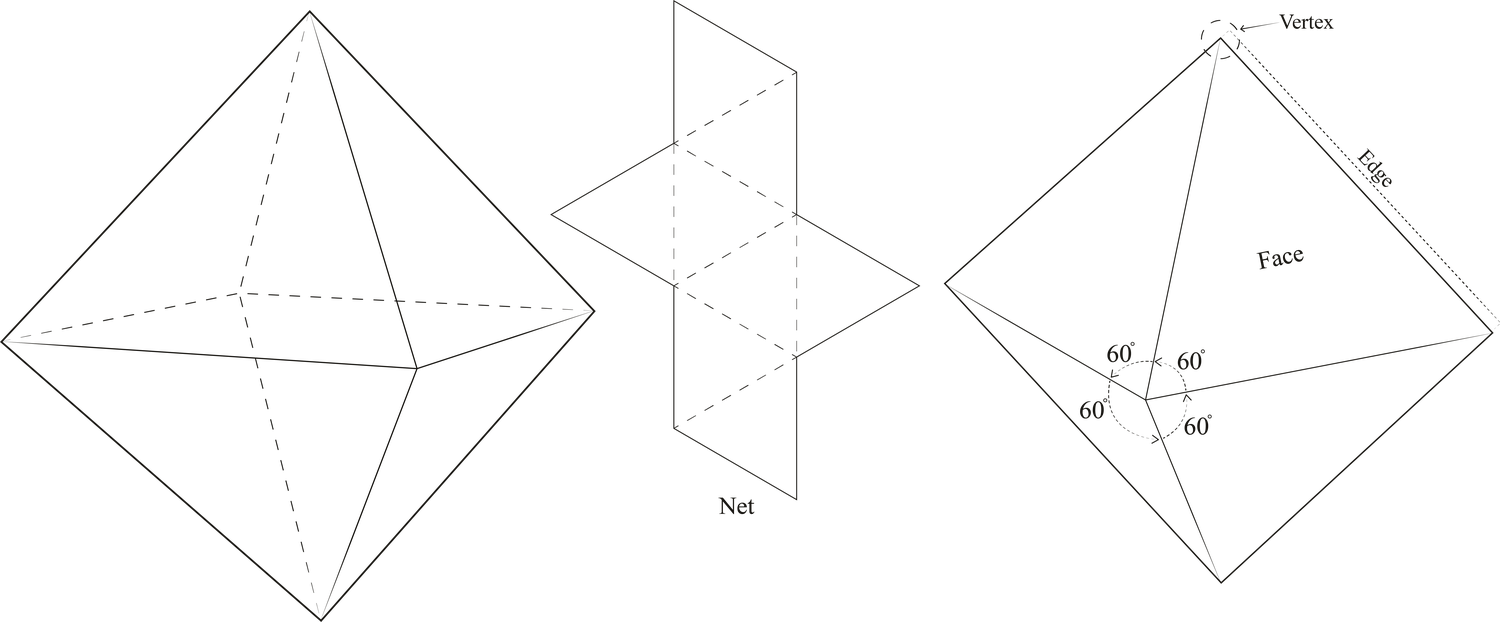
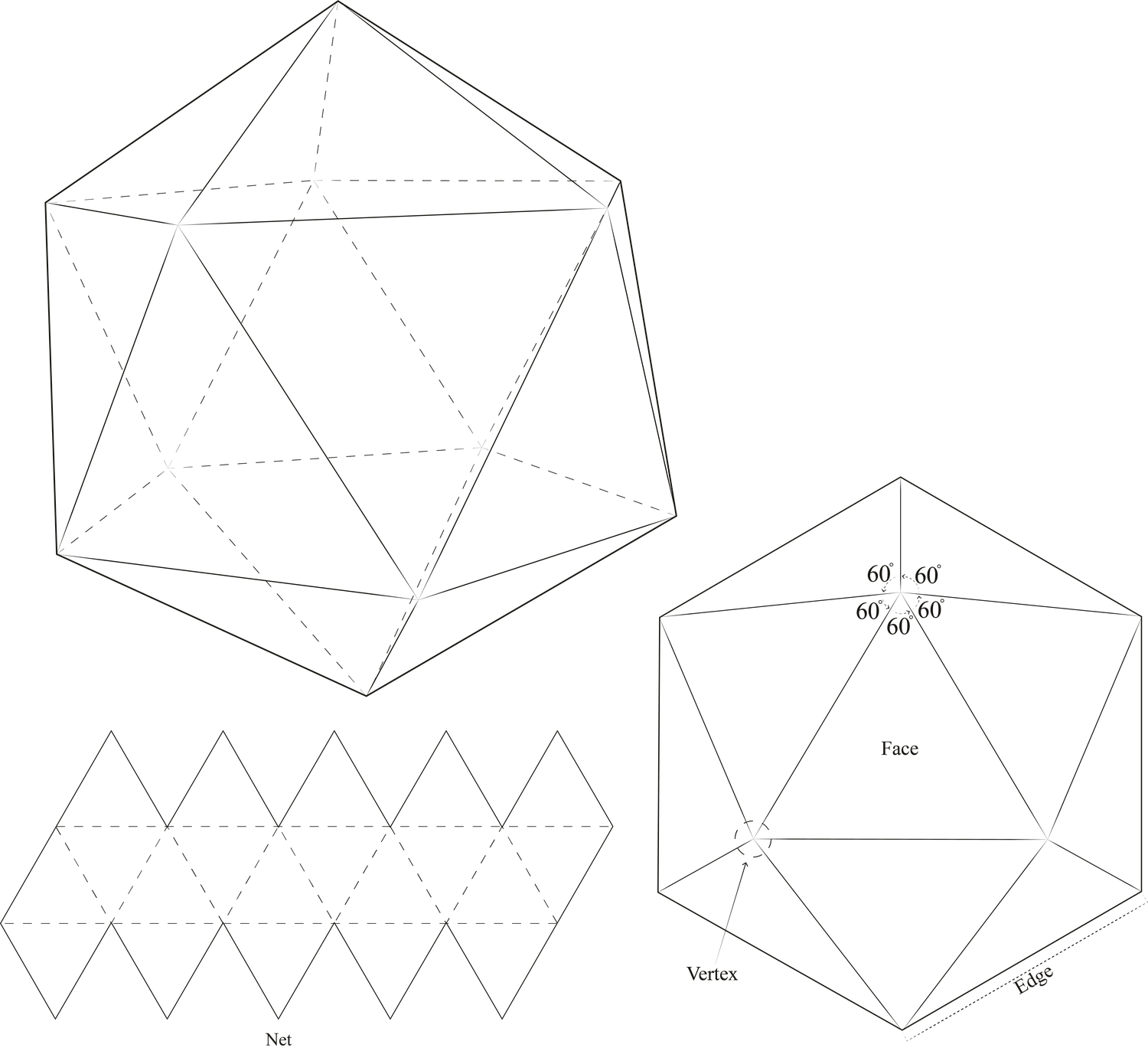
Cube
A cube (Fig.28) or hexahedron is made of 6 square faces and all sides of the cube are the same length. It consists of 12 edges, 6 faces, and 8 vertices. Since cubes are made of congruent squares, the length, breath, and height of a cube are the same. The angles between any 2 faces or surfaces (internal and dihedral angles) is 90 degrees. 3 squares meet at each vertex, therefore the internal angles at each vertex add up to 270 degrees (90x3). The dual of the cube is the octahedron.
Dodecahedron
A regular dodecahedron or pentagonal dodecahedron (Fig.29) is a platonic solid that consists of 12 pentagonal faces, which form 30 edges, and 20 vertices. 3 pentagons meet at each vertex, with internal angles of 108 degrees, summing up to 324 degrees (108x3). The dihedral angles are 116.56505 degrees. The dual of the dodecahedron is the icosahedron.
Of the infinite series of 2-d regular polygons, only 3-fold, 4-fold, and 5-fold n-polygons prove useful. Other n-polygons are too ‘round’ to form valid 3-d corners. As seen, this works for 3,4, or 5 triangles, 3 squares, or 3 pentagons around a shared vertex.
Euler provides an elegant formula to distinguish platonic solids from the infinite set of uniform polyhedra. According to Euler, the number of faces ‘F’ added to the number of vertices ‘V’ (corner points), subtracted by the number of edges ‘E’, always equals 2.
More simply, F + V - E = 2.
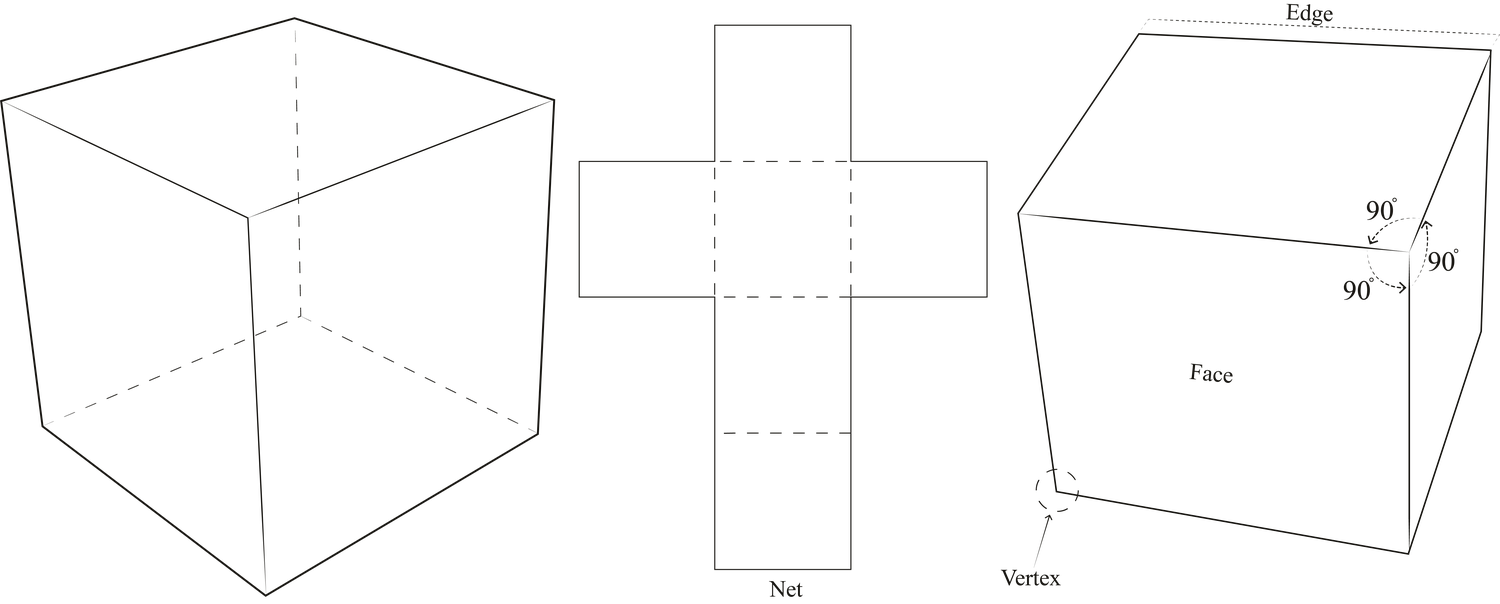
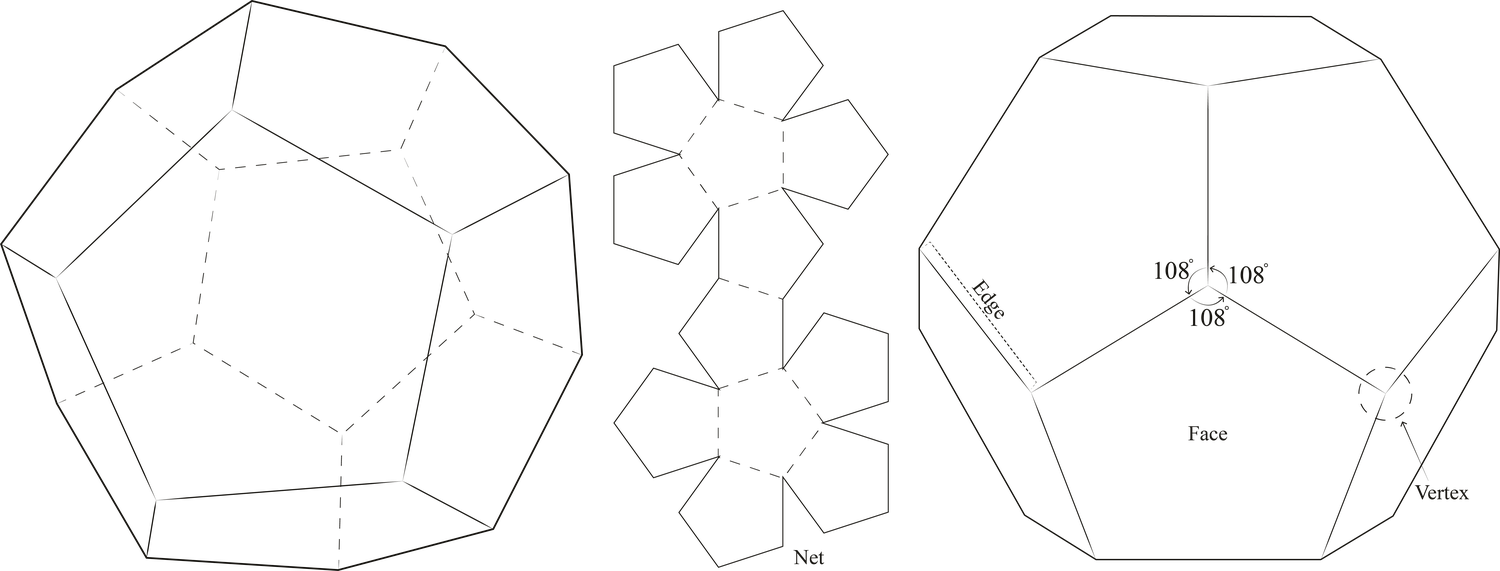
VThe Jitterbug and Platonic dipolygonids
The jitterbug is a set of eight identical regular triangles connected to one another by the vertices (Fig.30). It is a fascinating wireframe tensegrity model which contains the platonic solids within its motion. They can be seen as phases of a dynamic transformation process arising from the close-packing of spheres (Fig.31). These displacive transitions occur when the centre sphere is removed from the close-packing, allowing a series of twist-collapses. The system oscillates, expands, contracts, and folds over tetrahedrons, octahedrons, icosahedrons, to again end with the cuboctahedron.
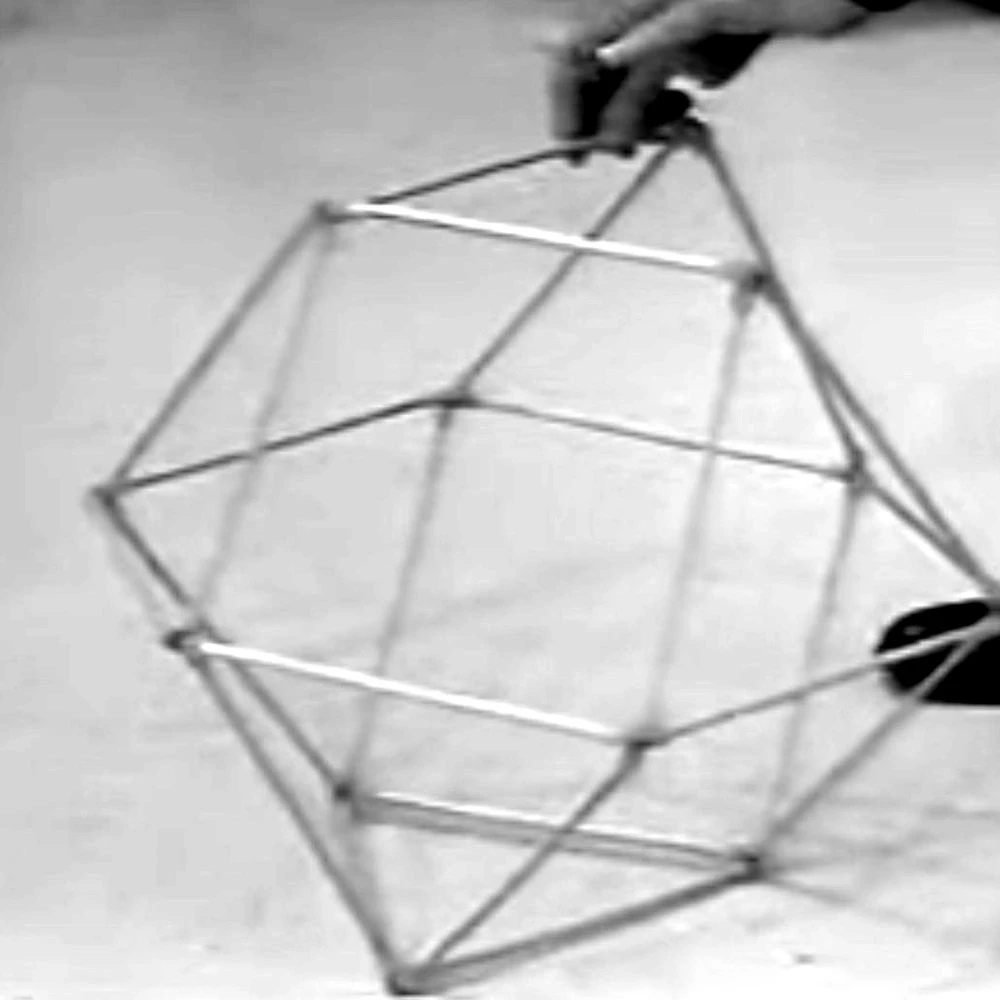
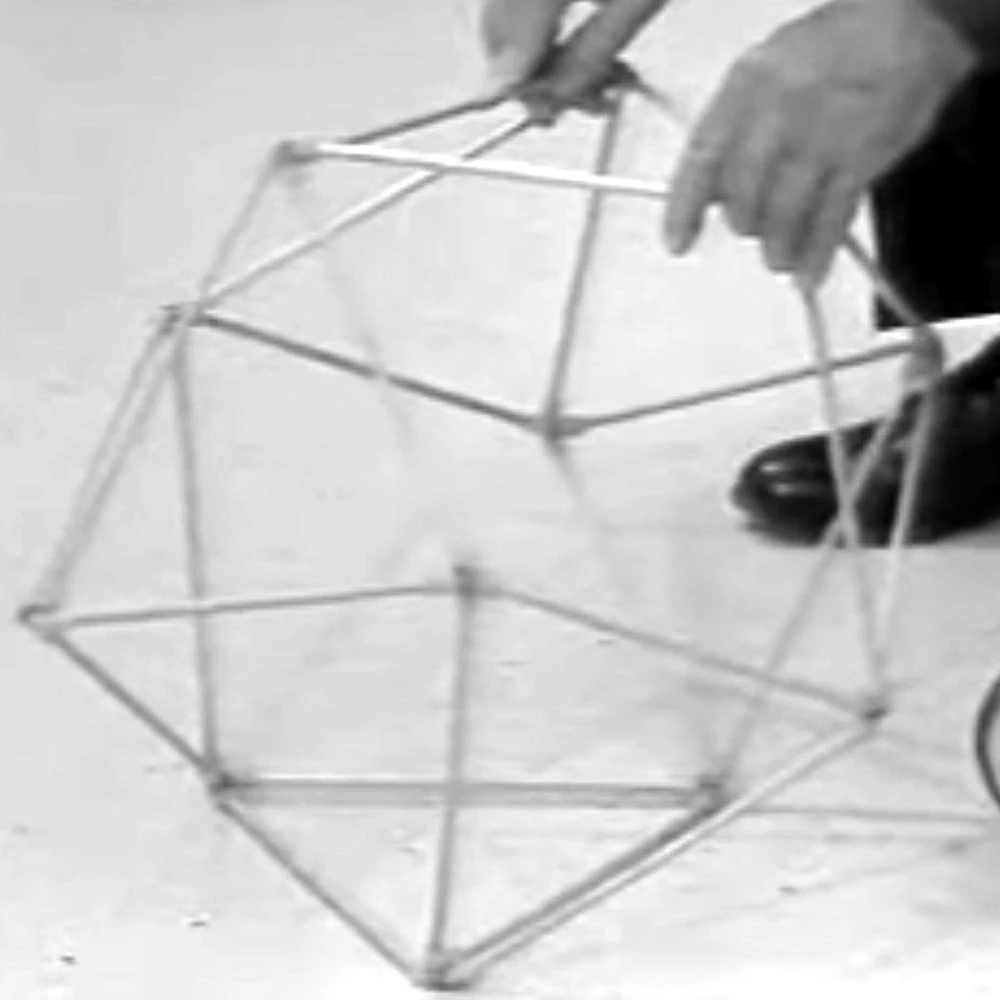
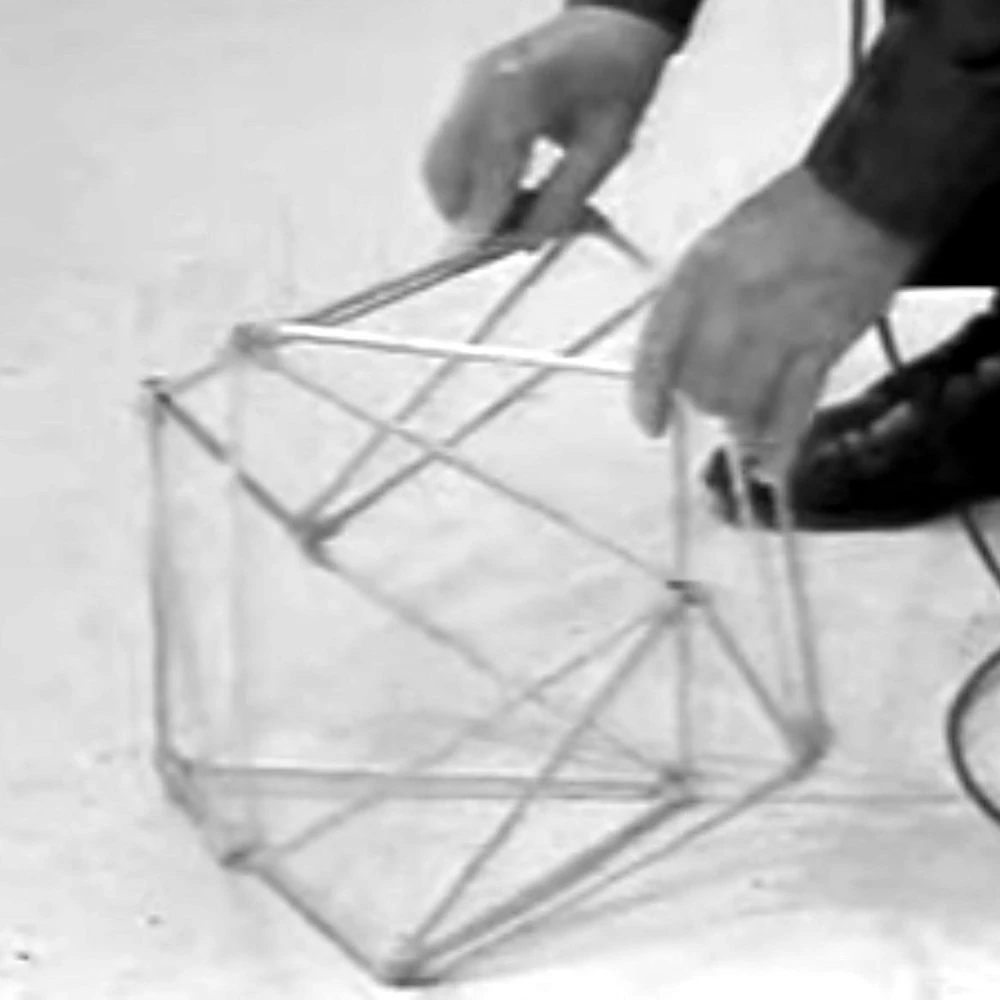
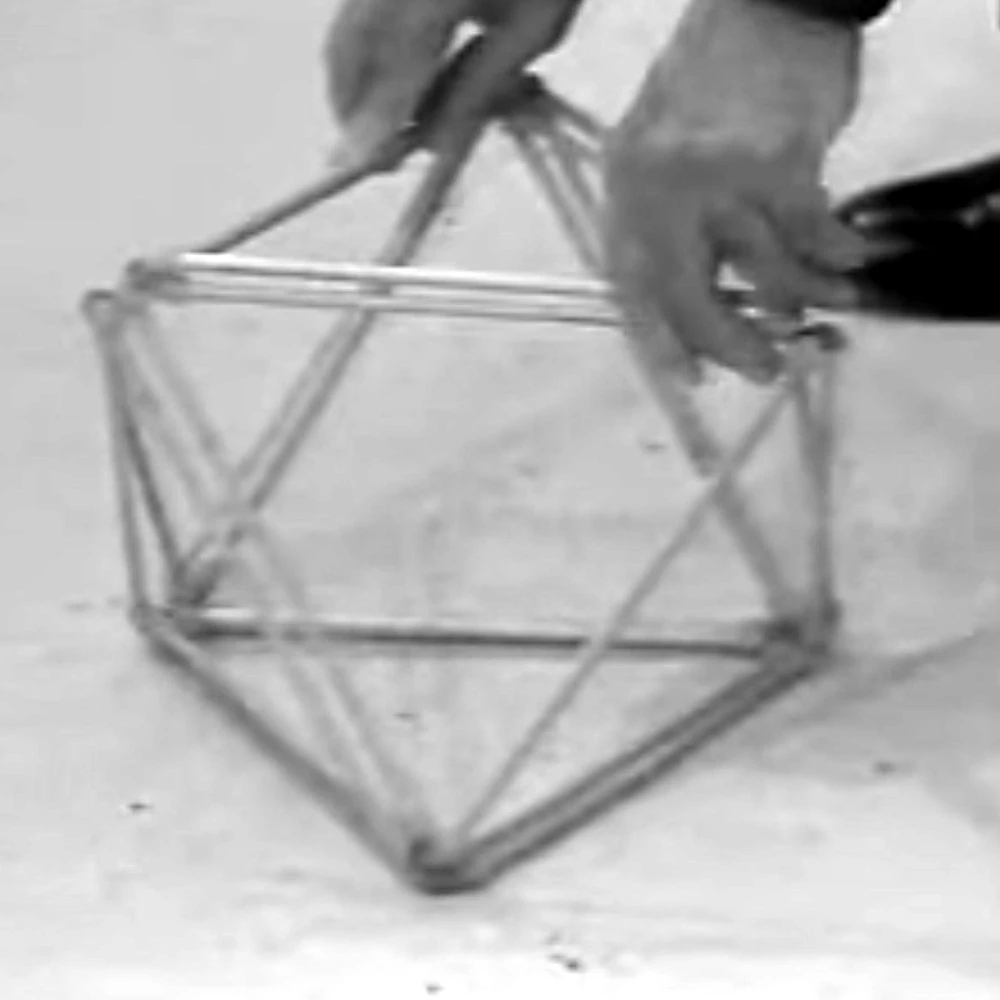


Buckminster Fuller describes the jitterbug as ‘the finitely closed, external vector structuring of a vector equilibrium model constructed with 24 struts, each representing the push-pull, action-and-reaction, local compression vectors, all of them cohered tensionally to one another’s ends by flexible joints that carry only tension across themselves, so that the whole system of only-locally-effective compression vectors is comprehensively cohered by omni-embracing continuous four closed hexagonal cycles’ tension.’ Fuller introduced it as an ‘energetic geometry’ which later inspired his rubric of synergetics.
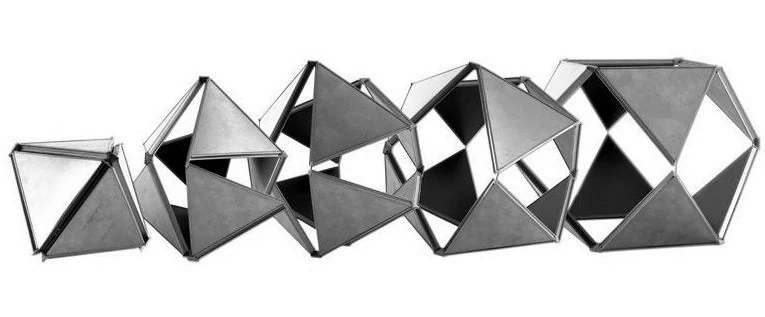
Fuller and Stuart extend his reasoning to create the ‘single-cell jitterbug’ by covering the equilateral triangle faces of the wireframe structure (Fig.32). This led Joseph Clinton to establish similar transformations between some more polyhedra. He added 2 faces to every side of the jitterbug model, thereby making them dipolygons. Adjacent dipolygons are connected with a binary alternating vertex connection system where the top layer of a dipolygon face is connected with the bottom layer of the adjacent dipolygon face. This over-constrains each face and the entire structure to only one angle of rotation. In these stable platonic transformations one can observe jitterbug-like structures appearing while one polyhedron transforms into another. These ‘dipolygonids’ are able to perform a symmetrical ex- and impansion motion, illustrating a transformation between, for example, the tetrahedron and octahedron (Fig.33).
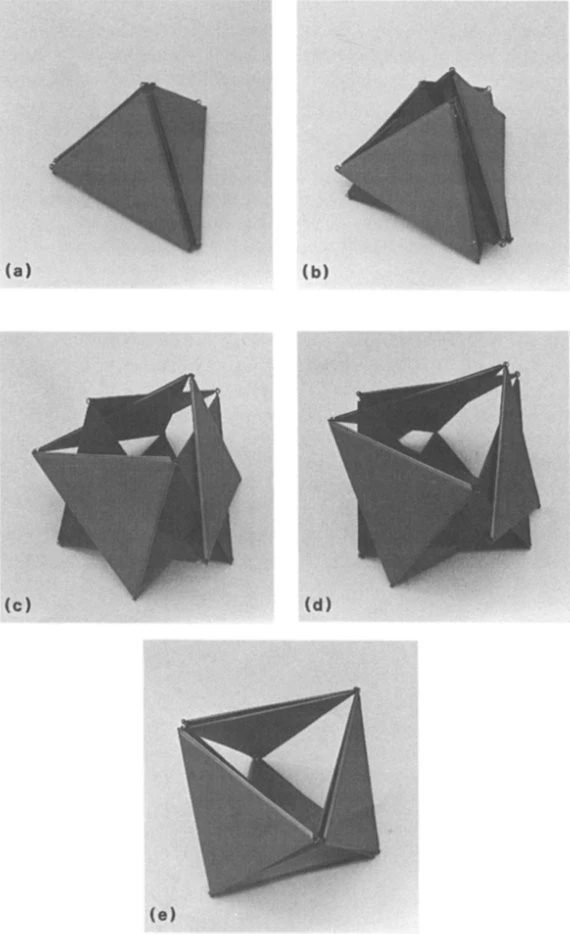
As Clinton observed in his paper on expanding rigid structures[1,2], each triangle is subject to a translation-rotation along its symmetry axis. When starting from the closed position in the tetrahedron, these axes are the four triangular symmetry axes of the tetrahedron. When describing cylinders about the triangles along the axes, each vertex common to two triangles moves along the intersecting curve of the two cylinders.
Both Clinton and Stuart extend the jitterbug transformation by starting this process at other platonic solids (Fig.34, Fig.35) and some archimedean solids too (Fig.36), thus establishing a number of jitterbug-like transformers in which :
- Each transformation starts from a platonic or archimedean solid, while certain rotational symmetries of that solid remain.
- The transformers are not symmetrical with respect to reflections which leave the solid invariant.
- The structures are composed of one or two types of polygons, all having equal edge length.
- The motion of the vertices is along the intersecting curve of two circumscribed cylinders.
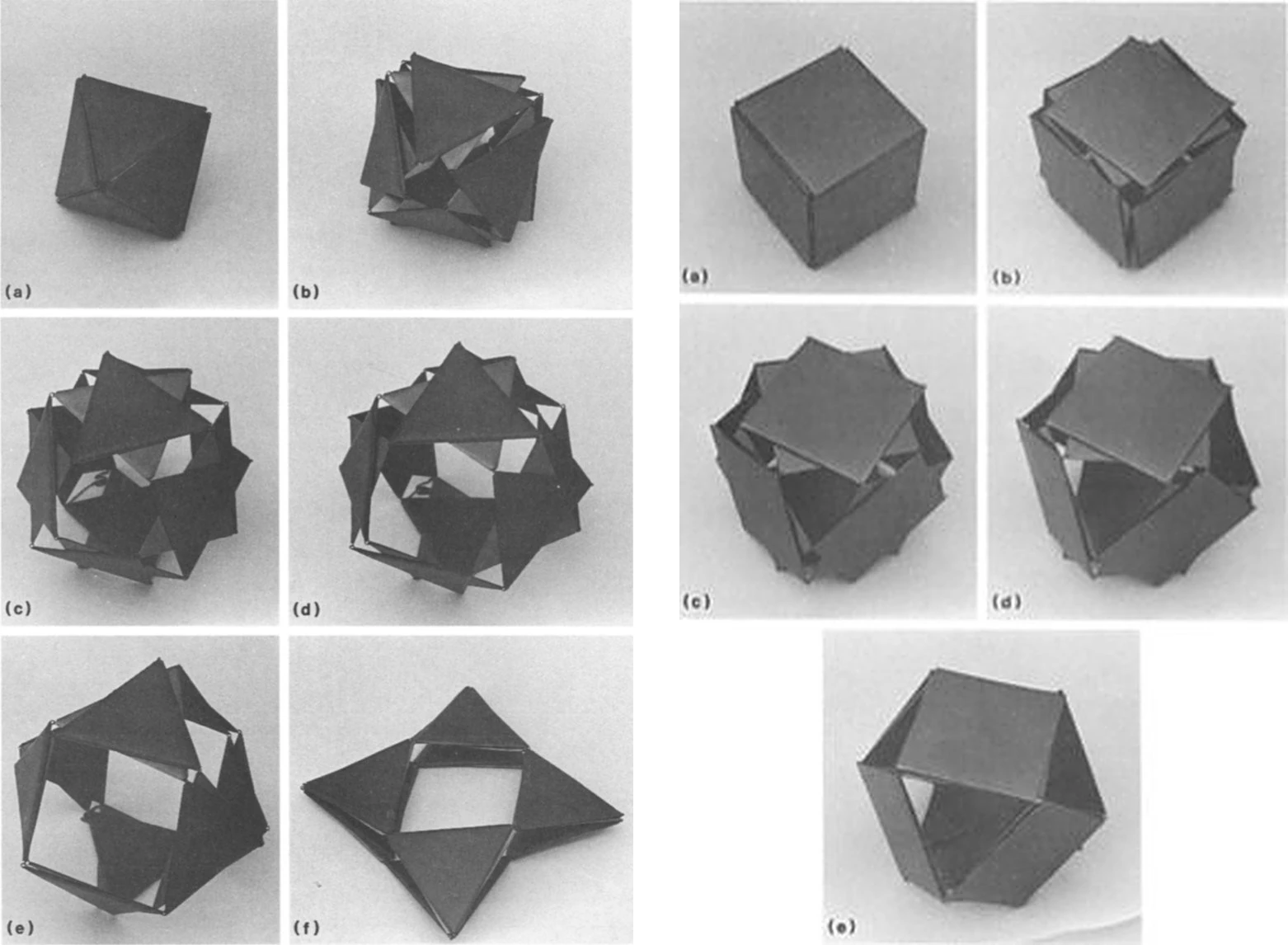
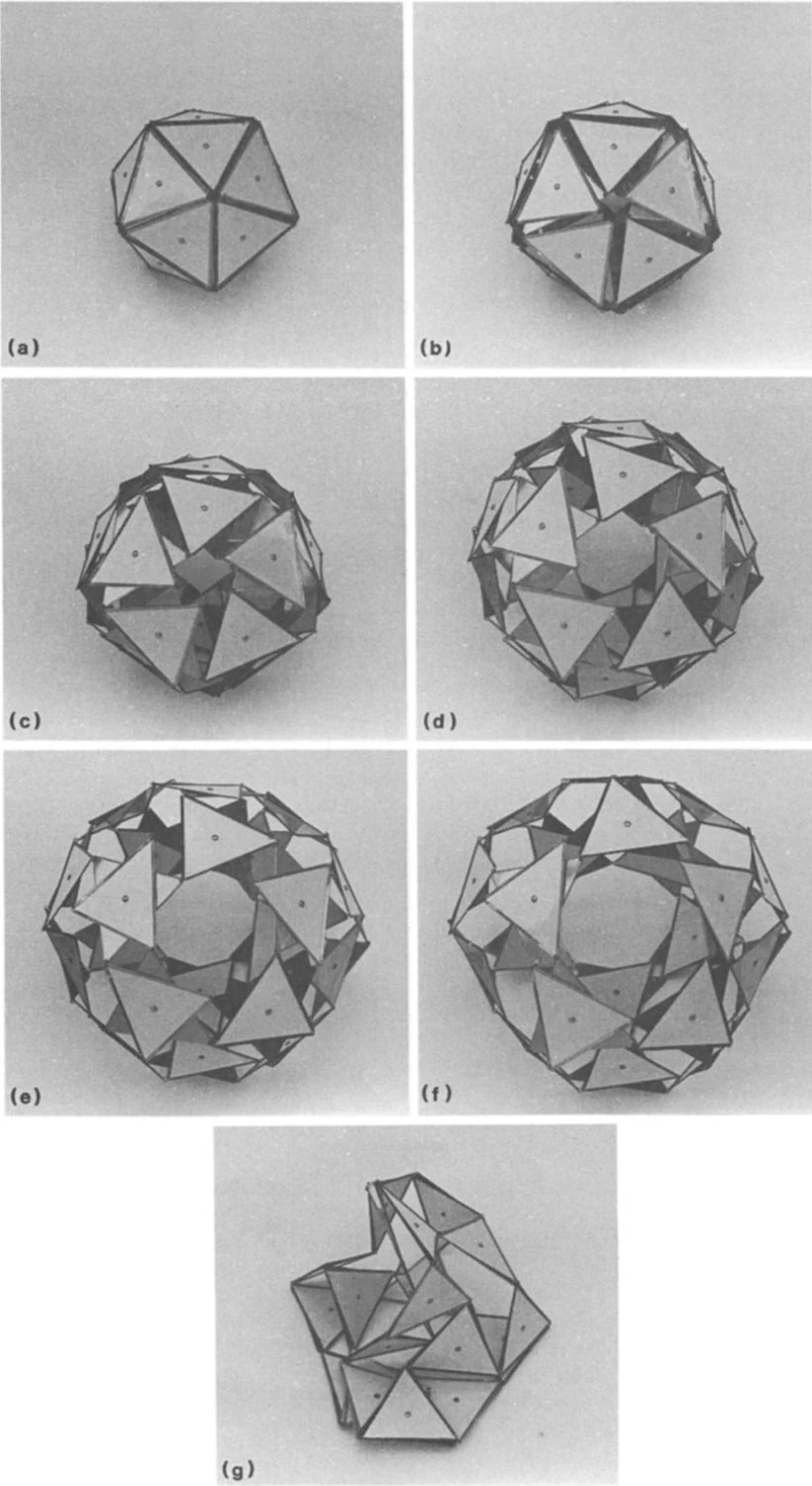
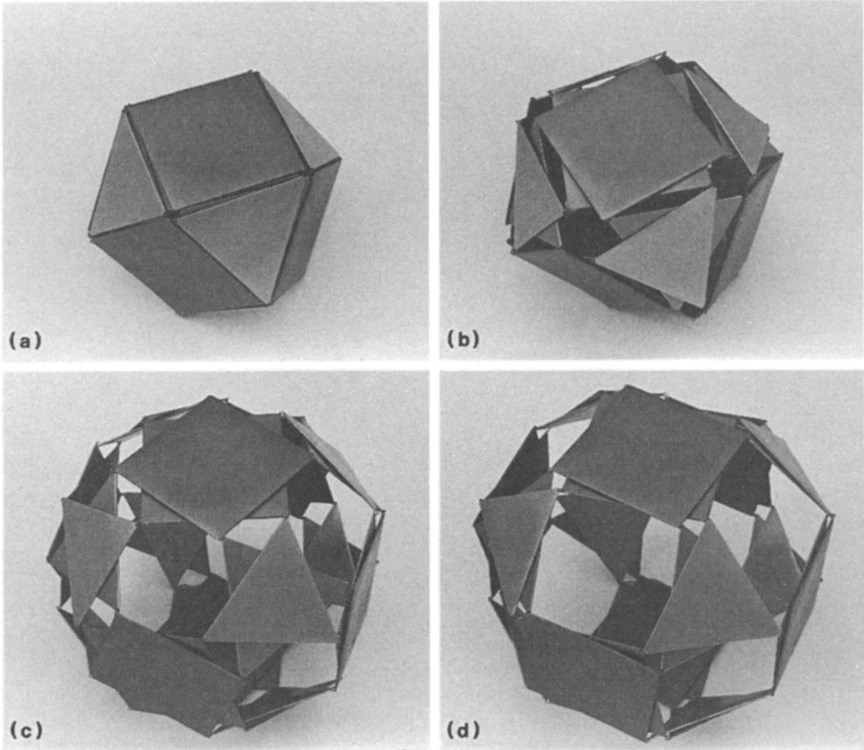
If one covers the gaps of an expanded dipolygonid with identical dipolygon modules and connects their vertices with adjacent faces using the same alternating rule, the resulting structure will expand further into another uniform solid. Theoretically one can continue this sequence of expansions to infinity i.e, a spherical dipolygonid with infinite facets. For example, the octahedron and cube dipolygonids both expand into the cuboctahedron (Fig.34). Covering the gaps of these dipolygonids in their expanded states results in a cuboctahedron dipolygonid which will expand further into the rhombicuboctahedron (Fig.36) which then expands further, and so on.
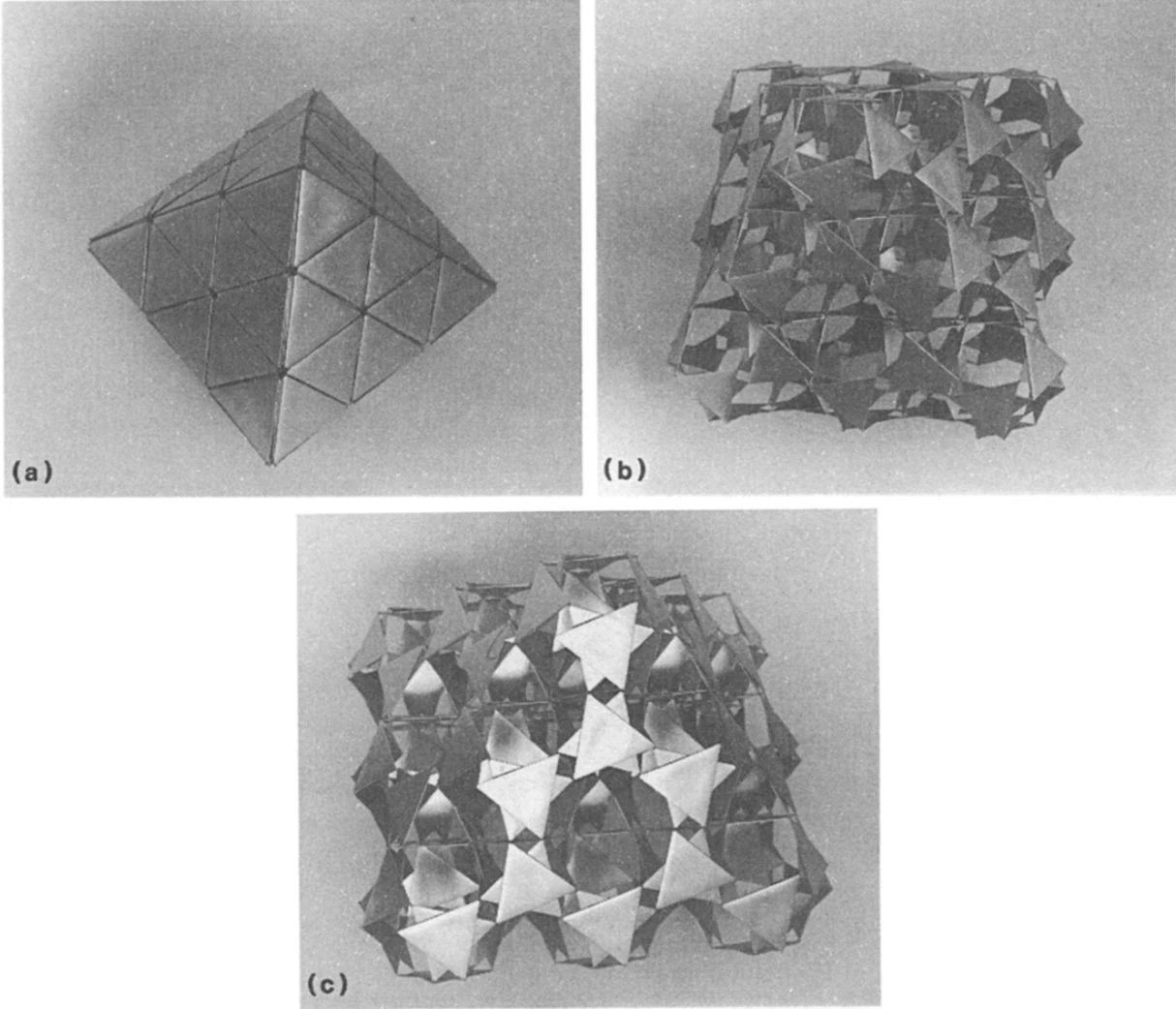
One can also construct modular dipolygonids from all the space-filling tessellations such as the cube lattice, as well as other 3-dimensional modular forms like the pyramid lattice. Coincidentally both these modular jitterbugs expand into a close-packing of the cuboctahedron-octahedron lattice (Fig.37).
VIRegular nested 3-dimensional moiré patterns
When self-similar transparent grids are applied to each face of a platonic dipolygonid, the rotation-translation creates a 2- and 3-dimensionally synchronous moiré and structural motion.
3-fold dipolygons and equilateral triangle tessellations are used in constructing the tetra-, octa-, and icosa- jitterbugs, each with 120 degree periodicity for the 3-fold interference pattern and platonic structure. 4-fold dipolygons and self-similar tessellations are used in constructing the cube, with 90 degree moiré periodicity and a 180 degree expansion-contraction cycle. 5-fold pentagons and quasicrystal tessellations are used in constructing dodecahedral jitterbugs, each with 72 degree periodicity and synchronicity.
Since the angle of symmetry of each rotating tessellation is synchronous with the angle of rotational symmetry of the overall structure — and they both exhibit the same n-fold symmetry — the result is a nested, multi-dimensional, regular, and periodic motion and moiré pattern. Each platonic dipolygonid with this self-similar property is perceptually fractal-like in its kinematics.
i. Tetrahedral — Moiré cell
Moiré-cell is the simplest regular 3-dimensional interference pattern (Fig.38). Tetrahedrons consist of 4 identical equilateral triangle faces. All edges are the same length, and its vertices are equidistant from the structure’s center. Hence it is 3-dimensionally and geometrically regular, one of five platonic solids. This jitterbug tetrahedron is constructed with 8 equilateral triangles, as there are 2 on each face. It employs an over-constrained spatial mechanism to expand and contract, creating 4 equilateral triangle gaps at 120 degrees of rotation. The resultant structure is an octahedron (8 triangles : 4 faces + 4 gaps), one of the other platonic solids. In a sense the tetrahedron expands into itself as the gaps are identical to the dipolygon faces, illuminating its self-dual property.
Each face has identical wireframe-transparency grids made of equilateral triangles. Rotation causes interference between overlapping grids, creating a ghost-like animation of telescoping equilateral triangles. This moiré pattern completes a full cycle at 120 degrees, as does the jitterbug’s expansion. Hence moiré-cell can be termed regular in the sense it consists of only equilateral triangles (the structure, grid, and interference), with 120 degree rotational periods in 2-d interference and 3-d structure.
As the faces rotate oppositely, the triangular pattern zooms in, and at 30 degrees of rotational expansion of the model, the animation magnifies into its most intricate dance. It zooms back out at 60 degrees, where the ghost pattern disappears as the grids overlap. This sub-period repeats for another 60 degree loop where the pattern is inverted, till the tetrahedral cell is fully expanded into an octahedron, or each equilateral triangle reaches 120 degrees of rotation vis a vis its face counterpart. One can observe the central triangle in the moiré animation point upwards at 59 degrees but downwards at 62 degrees of rotation of the grids, illustrating this sub-period inversion. Since moiré-cell is self-dual and its expansion leads to 4 triangular gaps, the 3-fold wireframe grid and interference are further appropriate.
The physical model is made of transparent 1mm thick acrylic sheets with graphic sticker-transparencies (Fig.39). Stickers are stuck on opposite sides of the two sheets on each face to prevent scratching of the patterns through wear and tear. The 1mm thickness of the sheets is enough for the moiré pattern to be apparent and thicker sheets further limit the structure’s expansion and contraction. Each dipolygon unit is connected with stainless steel rivets at the center, and by stainless steel rings at the vertices. Since its completely interconnected, one can expand the model by squeezing two adjacent vertices towards one-another, or with a chain that can be lifted to allow gravity to open the structure.
ii. Octahedral — Moiré diamond
Moiré-diamond is the second regular 3-dimensional interference pattern. Octahedrons consist of 8 identical equilateral triangle faces. All edges are the same length, and its vertices are equidistant from the structure’s center. Hence it is 3-dimensionally and geometrically regular, the second of five platonic solids. The jitterbug octahedron is constructed with 16 equilateral triangles, as there are 2 on each face. It employs an over-constrained spatial mechanism to expand, creating 6 square gaps at 120 degrees of rotation. The resultant structure is the cuboctahedron (8 triangular faces + 6 square gaps), one of the archimedean solids. This kinematic shows us the cube is dual to the octahedron.
If one superimposes wireframe 3-fold grids, the 2- and 3-dimensional interference and structural periodicities would be synchronous at 120 degrees, as is with the tetrahedral moiré-cell and icosahedral moiré-jewel (Fig.38, Fig.39, Fig.41).
Since this octahedral-diamond transforms into a cuboctahedron causing 6 square gaps to emerge, the 3-fold alternately checkered grids (black and transparent triangles, where the two layers have alternate colour arrangements) create an appropriate superimposition for the dipolygon modules — and the interference they produce across the transforming structure is, remarkably, 4-fold.
In this case the nested 3-fold rotations are 4-fold twice over: the structure opens 6 square gaps, and on the physical model the 3-fold checkered faces read through one another as a square moiré — both completing one period of symmetric rotation in 120 degrees. How a 4-fold interference arises here from 3-fold checkered grids, when the same pair on the plane produces a 3-fold moiré (Fig.21), is a question this paper leaves open.
The digital sequence (Fig.40, below) is opaque when fully closed because the black triangles of the two grid layers alternately overlap on every face; the physical model (above) instead carries the 4-fold moiré ghosting through its checkered faces as the square gaps open. The structure expands and contracts through 240 degrees — room for two full 120 degree periods of the checkered interference in each direction of travel. A chiral octahedral transformation (Fig.48) carries six full periods of the checkered interference within its structural cycle of 720 degrees.
iii. Icosahedral — Moiré jewel
Moiré-jewel is the third regular 3-dimensional interference pattern. Icosahedrons consist of 20 identical equilateral triangle faces. All edges are the same length, and its vertices are equidistant from the structure’s center. Hence it is 3-dimensionally and geometrically regular, the third of five platonic solids. This jitterbug icosahedron is constructed with 40 equilateral triangles — 2 on each face. It employs an over-constrained spatial mechanism to expand, creating 12 pentagonal gaps at 120 degrees of rotation (Fig.35). The resultant structure is the icosidodecahedron (20 triangular faces + 12 pentagon gaps), an archimedean solid. This kinematic expansion shows us the dodecahedron is dual to the icosahedron.
If one uses wireframe 3-fold grids, the 2- and 3-dimensional interference and structural periodicities would be synchronous at 120 degrees, as is with the tetrahedral moiré-cell and octahedral moiré-diamond. In Fig.41 moiré jewel expands and contracts through 240 degrees, as seen from an orthographic perspective with a vertex-view of the icosahedron.
iv. Hexahedral — Moiré box
The regular 4-fold period cycle is a nested 2- and 3-dimensional symmetry of squares. Cubes consist of 6 identical square faces. All edges are the same length and its vertices are equidistant from the structure’s center. Hence it is 3-dimensionally and geometrically regular, the fourth of five Platonic solids. This jitterbug cube has 12 squares, two on each of the six faces. A dipolygonid kinematic mechanism allows the cube to expand, creating 8 equilateral triangle gaps at 90 degrees of rotation. The resultant geometry, a cuboctahedron (6 square faces + 8 equilateral triangle gaps), is a semi-regular archimedean solid, and this kinematic shows us the octahedron is dual to the cube.
When in motion, the rotational interference of overlapping self-similar 4-fold wireframe grids creates a ghost-like animation of telescoping squares with a periodicity of 90 degrees (Fig.42).
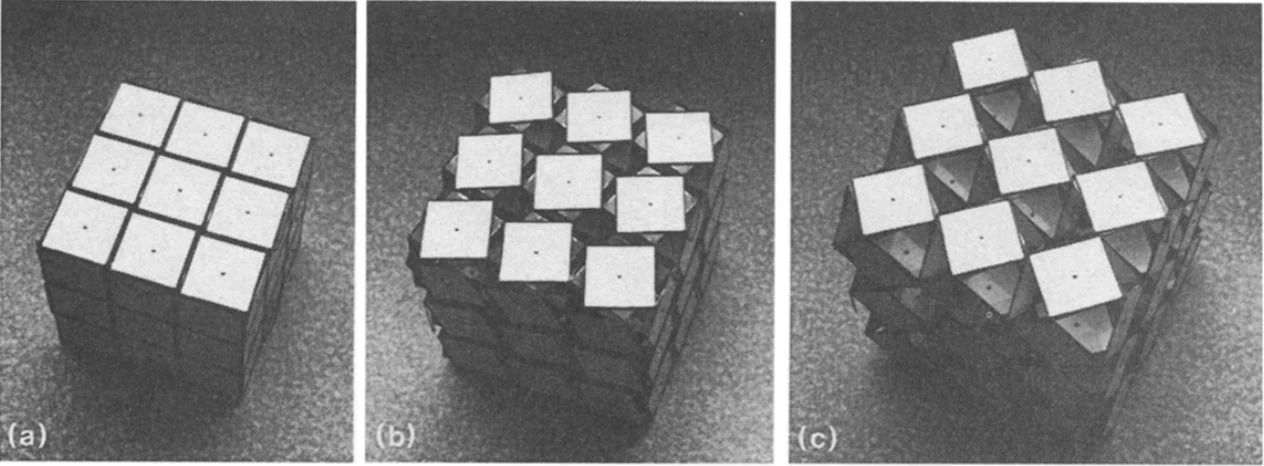
Checkered-transparency grids — where the outer and inner layer have alternate combinations of black and transparent squares — complete a cycle i.e, 1 period, at 180 degrees — the signature of grids pivoted on a lattice vertex, where a quarter turn exchanges the two colours (the face-pivoted pair of Fig.22 closes in 90 degrees). The jitterbug also completes an expansion-contraction cycle in 180 degrees. When seen head on, an opaque black square is visible if the structure is fully contracted (Fig.43, Fig.44). Moiré-box is thus regular because the structure, grids, and interference are all squares, with a periodic interval of 90 or 180 degrees in interference and structure.
Since 2-dimensional moiré patterns require tessellations i.e, two identical grids of regular polygons, one can use the space-filling property of cubes to create a 3-dimensionally modular and nested tessellation-symmetry as well. In a sense this would be a truer 3-dimensional moiré than a single unit of the moiré box. By superimposing 4-fold wireframe or checkered grids on a cube lattice dipolygonid as seen in Fig.37, this is achieved. Similarly, the triangular pyramid lattice that’s seen in Fig.37 can be made transparent and superimposed with 3-fold graphic-sticker grids, creating a nested and modular 3-dimensional 3-fold interference pattern. We can maintain the regularity of an octahedral symmetry in this case by using 2 such pyramids — one on top of the other, with the bottom inverted. These ‘modular-moirés’ can be made chiral as well (Fig.50, Fig.53).
v. Dodecahedral — Quasi-cells
3-dimensional 5-fold quasi-cells with pentagonal symmetry have 72 degree moiré periodicity and a 144 degree structural rotation. I have superimposed and rotated identical quasicrystal patterns on each face of a physical dodecahedron transformer to create circular dot interferences embedded in their geometries, revealed through the kinetic motion of the sculpture (Fig.45).
This dodecahedron kinetic transformer was a fitting backdrop to these rotational experiments since it’s made of 12 pentagons, which also exhibit 5-fold symmetry. When the structure expands, the 20 triangular gaps together make an icosahedron (dual to the dodecahedron), which adds up to form a gorgeous icosidodecahedron.
I’ve used 5-fold Penrose tiling, Shechtman’s 10-fold X-ray diffraction image of the molecular structure of Al86Mn14 (aluminium manganese), an icosahedral quasi-symmetry, and 2 more molecular lattice symmetries that are 8- and 12-fold. The dodecahedron is a meaningful kinetic backdrop for these projections and their beautiful rotational dances.
VIIChiral transformations
In a sense a true 3-dimensional moiré pattern would require a full chiral transformation, where each face passes through the center of the platonic jitterbug and the dipolygons turn inside-out or invert, creating a 720 degree structural cycle.
Dipolygon modules have 2 layers. One of these layers rotates clockwise while the other rotates counter-clockwise. This gives chirality to dipolygonid transformations. In geometry, a figure is chiral if it is not identical to its mirror image, or, more precisely, if it cannot be mapped to its mirror image by rotations and translations alone.
The physical dipolygonids are limited in their expansions by the connection system, allowing motion up to one translation. Once the structure is fully expanded, it can only be contracted by a symmetrical rotation in the opposite direction of the expansion.
In the mathematical realm, chiral transformations can continue through a 720 degree rotation for all the platonic dipolygonids, where the opposite dipolygon faces pass through each other, becoming congruent in the process. This was first observed by Joseph Clinton. Each group of rotations has a point of invariancy O, being the one point of intersection of all axes of these rotations. Chiral structures invert after each dipolygon face passes through this center O. It is an interesting ‘double-duality’ as the moiré patterns (that have 2 sub-periods within each periodic interval) also invert after 1 sub-period.
In this paper, regular polygons have been defined by a rotation around a point O. The advantage here is the consistency in generating higher groups of rotational symmetries. For example, a 3-dimensional chiral transformation goes through a 720 degree rotation, with all faces passing through the point of invariancy O, and each dipolygon module is rotated about the center of its face, O. This creates a truer 3-dimensional interference as it is a symmetrical rotation of regular polygons and platonic jitterbugs. Here a symmetrical rotation cycle is defined as a transformation which preserves the shape and position of an object.
In the case of the cube, the axis of rotation in 2-dimensions is through the center of its squares O, which are 0-dimensional points on a plane where each dipolygon face is conjoined (Fig.5). The center of rotation in 3-dimensions is the intersection of the cube’s symmetry axes, O, a point of invariancy in space. Later, we will extend this reasoning into higher dimensions as well.
Adrian Rossiter has created boolean-like visuals for these chiral polyhedra. One has to imagine superimposing wireframe grids and their moiré patterns from previous figures to Rossiter’s models, to truly visualise 3-dimensionally symmetric and periodic moiré patterns.
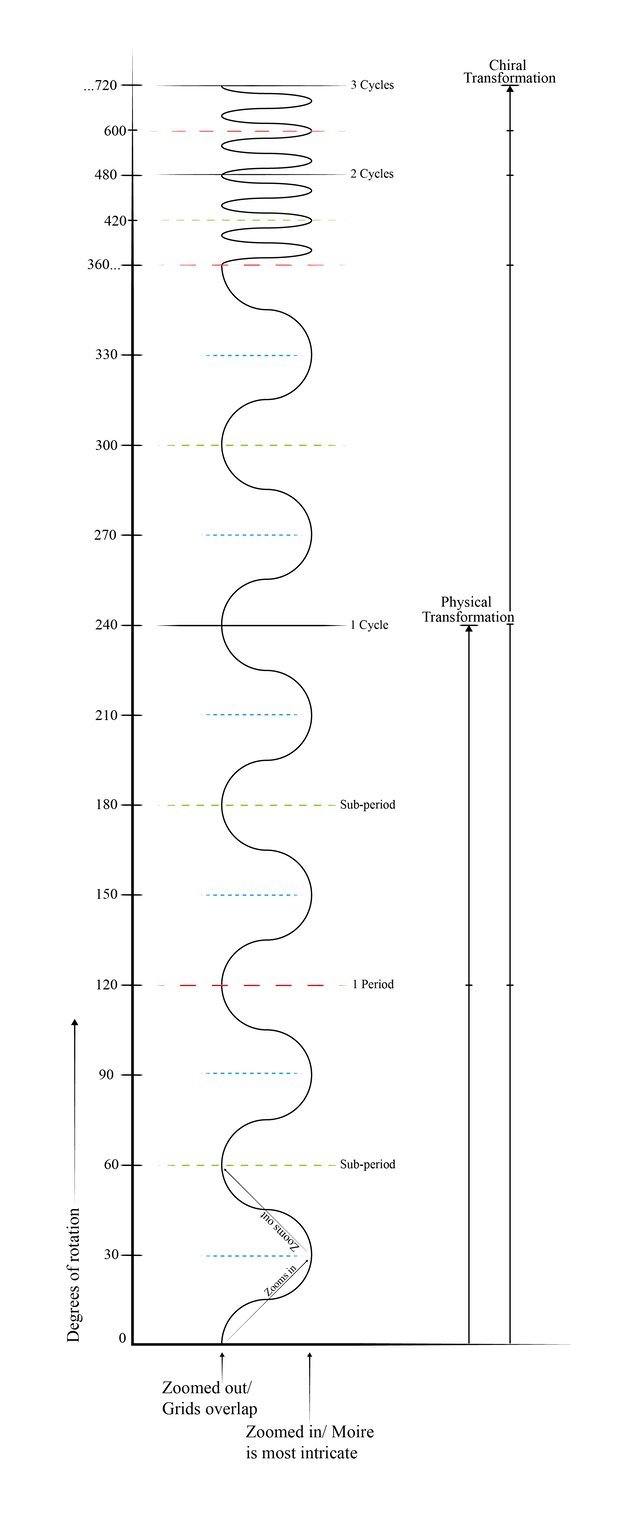
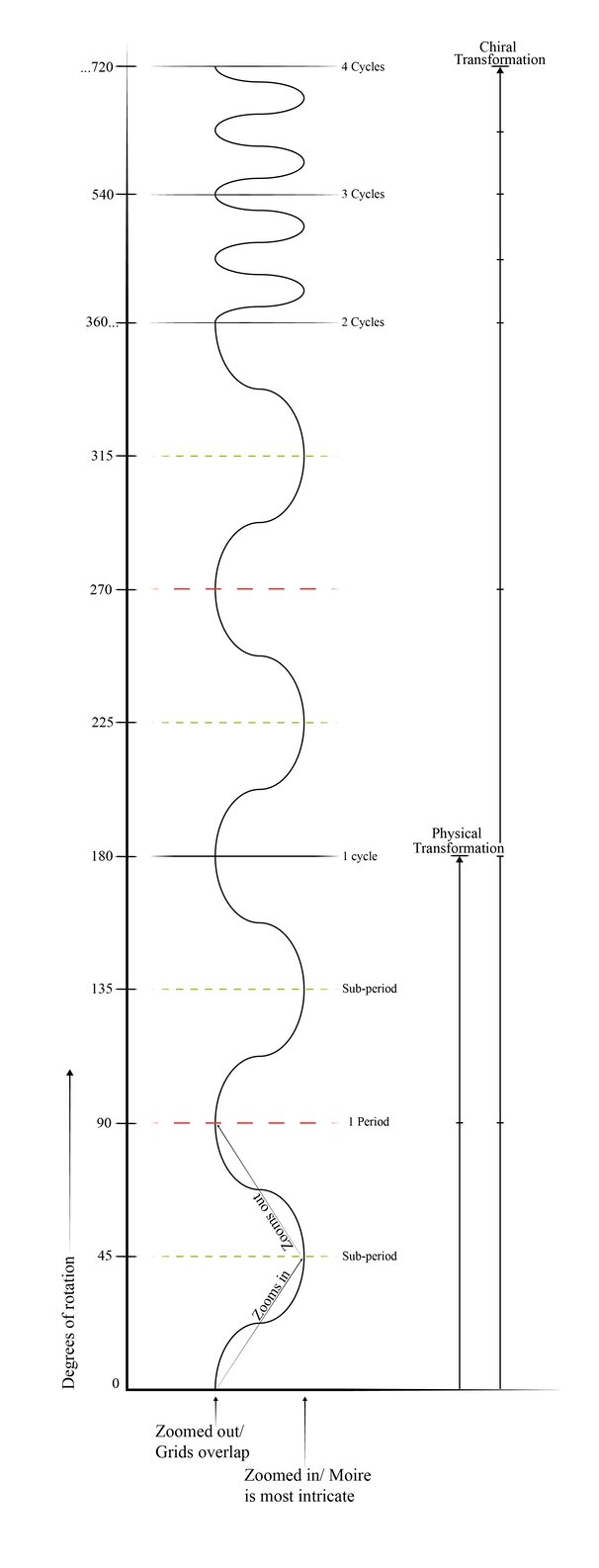
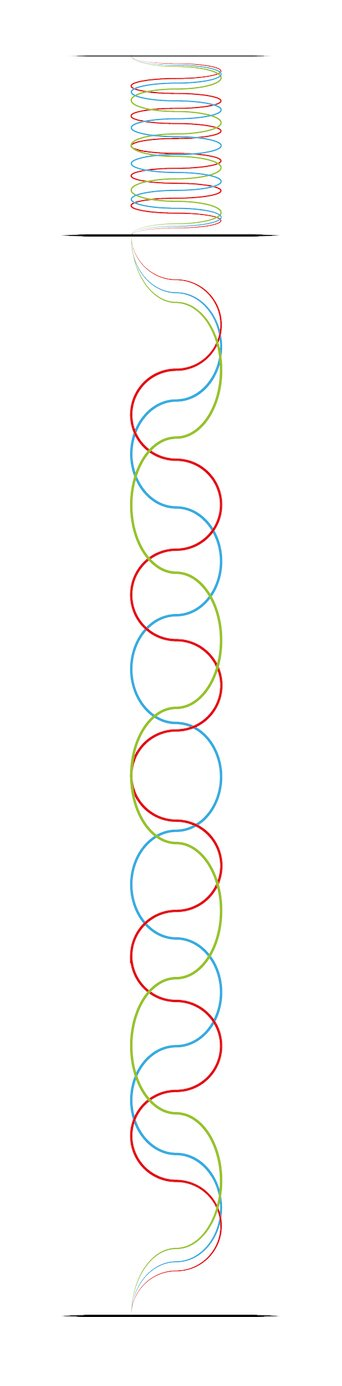
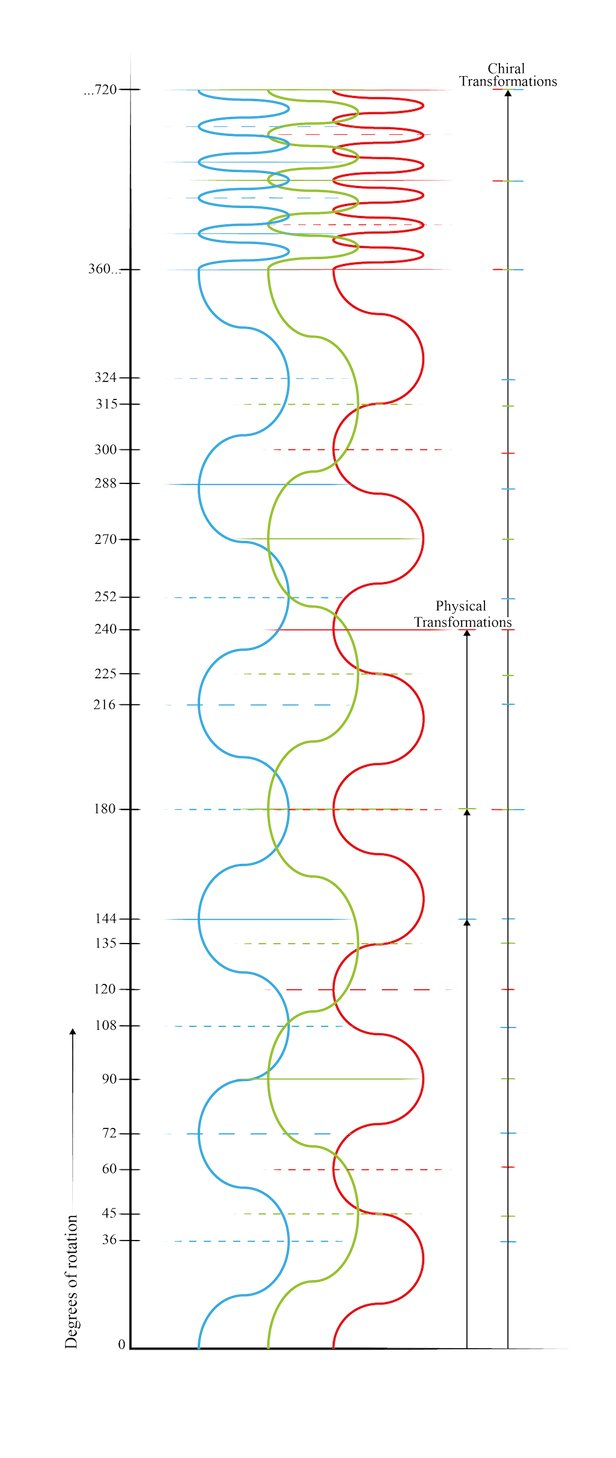
The sine wave of moiré periodicity, and structural rotation-translation cycle for the 3-fold, triangle-based self-similar structures are shown in Fig.46. One can also observe the tetrahedral, octahedral, icosahedral, and octahedra-tetrahedra lattice’s chiral transformations through 720 degrees (Fig.47, Fig.48, Fig.49, Fig.50).
In Fig.47 we see the tetrahedral jitterbug begin at the expanded octahedron state, from where it contracts through the tetrahedron and stellated octahedron phases with blue 3-fold polygons on the top layer of each dipolygon face. As these faces pass through the center-point of invariancy O of the form the structure inverts as the crimson polygons are now on top (on the exterior) of each dipolygon module. From here it unfolds and expands into a crimson stellated octahedron, tetrahedron, and octahedron, then reverses and passes through O again, reverting to the blue-exterior, and continues through the blue stellated octahedron and tetrahedron phases to end with a symmetrical 720-degree rotation cycle in the original octahedral position. This structural inversion occurs in all chiral transformations.
If we superimpose transparent wireframe 3-fold grids on self-similar 3-fold dipolygon faces of this tetrahedral chiral transformation, we create self-similar moiré patterns of equilateral triangles with six 2-dimensional moiré-periods within one 3-dimensional chiral cycle (Fig.46). The interference and structure invert halfway through their periodicities and cycle, revealing their duality. This is true for the tetrahedral, octahedral, icosahedral, and octahedra-tetrahedra lattice arrangements in their chiral moiré forms.
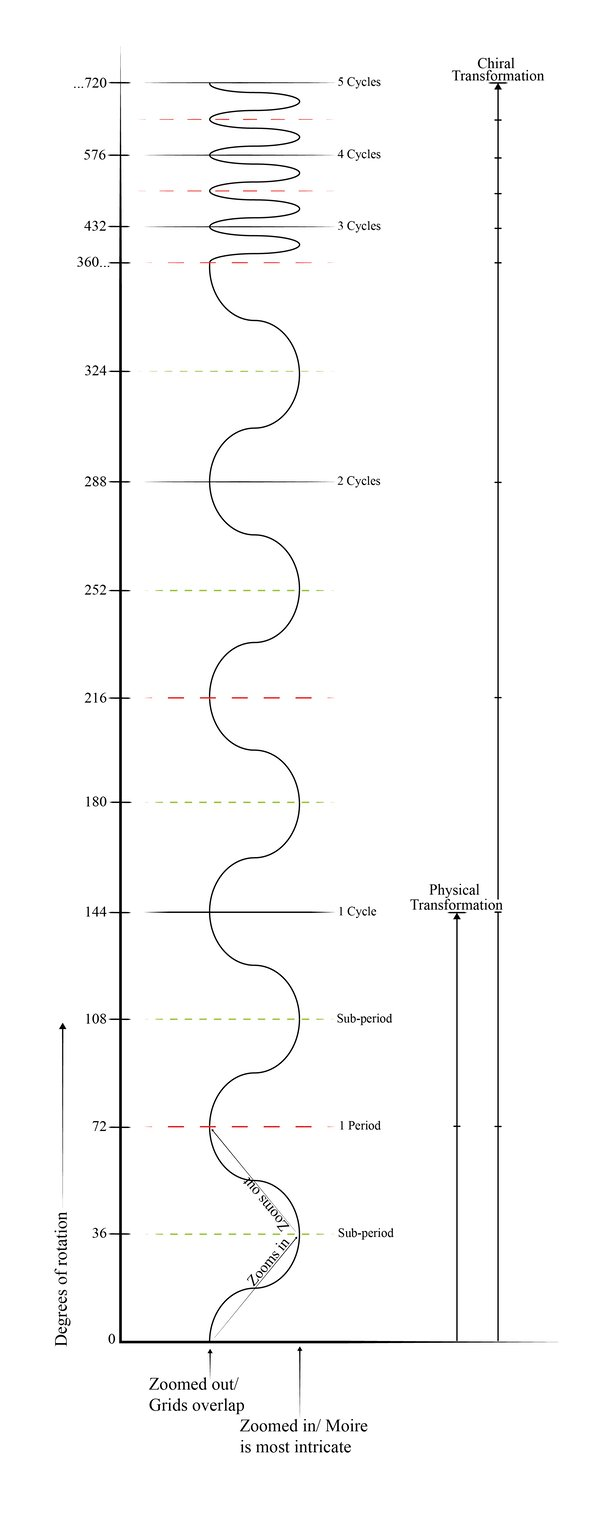
Superimposing self-similar 4-fold grids on the 4-polygons of a chiral cube would create 4-fold moiré patterns with 90 degree periodicity, thereby having eight 2-dimensional moiré-period intervals within one 720-degree 3-dimensional chiral cycle (Fig.51, Fig.52), or 2 periods within one physical cube dipolygonid expansion-and-contraction (Fig.42). The same is true for the 3-d cube lattice (Fig.53). Vertex-pivoted checkered 4-fold grids, as in the physical model, have four 180-degree periods in a chiral cycle; the face-pivoted pair of Fig.22 would complete eight. The chiral dodecahedron superimposed with 5-fold aperiodic patterns such as Penrose tiling have moiré periodicity of 72 degrees, with ten 2-d periods within one 3-d 720-degree structural cycle (Fig.54, Fig.55). In Fig.56 we see the sine wave periodicity and structural cycle of every platonic jitterbug.
VIIIRegular polytopes by dimension
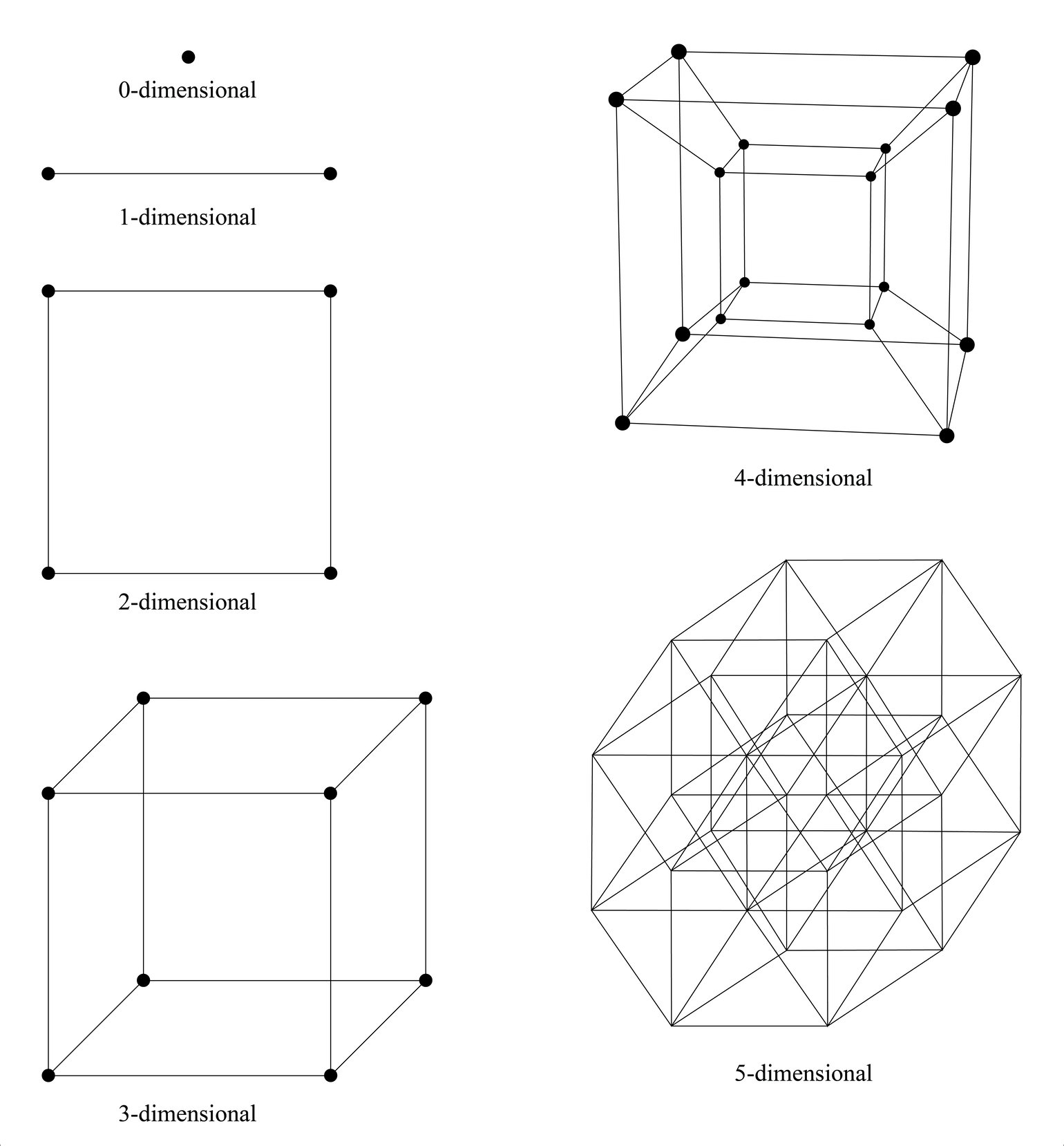
A 0-dimensional shape is a single point in space, or on a plane. Hence there is only one regular shape in the 0th dimension, a point.
In 1-dimension, we may extend this point-like shape into a straight line of any length, hence there is also only one regular shape in 1-dimension, the straight line.
We’ve discussed the infinite 2-dimensional series of regular polygons constructed with lines, which extends to a circle at infinity, as well as the five Platonic solids that exhibit regularity in 3-dimensions.
Just as a series of conjoined points from the 0th dimension make a 1-dimensional line, and equilateral-equiangular congruent lines create the regular polygons in 2-dimensions, of which three are able to construct the five regular polyhedra in 3-dimensions, i.e, 3-, 4-, and 5-gons, we may use this reasoning to surmise regular shapes in n-dimensions.
As Carlo H. Séquin points out, there are six regular 4-dimensional polytopes that can be constructed using 3-dimensional polyhedra. Each shape is constructed with only one type of regular 3-dimensional polyhedron as a crust or surface, where all corners and edges between these ‘cells’ are the same. For example, we construct cubes out of squares by sweeping out their volume, so we make a hypercube out of cubes on its surface, around a shared corner. The tetrahedron, octahedron, cube, and dodecahedron all translate into 4-dimensional regular polytopes, but the icosahedron does not because it has a very shallow dihedral angle of 138~ degrees, not allowing for a valid shared corner. The tetrahedron can be extended into three regular 4-dimensional shapes, whereas the octahedron, cube, and dodecahedron extend into only one regular 4-dimensional polytope each :
Tetrahedral
- Simplex or 5-Cell — 3 tetrahedra around a shared edge.
- Cross polytope or 16-cell — 4 tetrahedra around a shared edge, 8 around a corner. Dual to the hypercube.
- Tetraplex or 600-Cell — 600 tetrahedra with 20 meeting at each vertex, hence it is the 4-dimensional analogue of the icosahedron. Dual to the 120-cell.
Hexahedral
- Tesseract or Hypercube or 8-cell — 8 cubes with 3 around a shared edge. It has 16 vertices, 32 edges, and 24 faces.
Octahedral
- Octaplex or 24-cell — 24 octahedra with 3 octahedra around a shared edge, 6 around a shared vertex.
Dodecahedral
- Dodecaplex or 120-cell — Made of 120 dodecahedra in a thick crust, with 4 meeting at each vertex.
For regular 5-dimensional polytopes, we use regular 4-dimensional polytopes that have dihedral angles such that a set of them can fit around a shared edge to make a valid corner. Most are too round (as they have shallow dihedral angles) to create higher dimensional polytopes. Only the tetrahedral, hexahedral, and octahedral 4-dimensional polytopes i.e, the simplex (5-cell), the hypercube (8-cell), and the cross polytope (16-cell), translate to n-dimensional polytopes; the octaplex (24-cell) is the exception, existing in 4 dimensions alone. Therefore there are only 3 regular polytopes in any dimension higher than 4-dimensions.
First is the simplex series: raising a single new vertex above the center of gravity of the n-dimensional simplex, equidistant from all of its vertices, creates the n +1 dimensional simplex.
The second set that works for all higher dimensions is the hypercube series (Fig.57). They are the equivalent of the cube in higher dimensions, with which we measure 3-dimensional space, just as we use squares to measure 2-dimensional space and 8-cells 4-dimensional space. This occurs by stepwise extrusions. Squares when extruded perpendicular to themselves create cubes, cubes extruded perpendicular to themselves create the tesseract, hypercubes extruded perpendicular to themselves creating 5-dimensional measure polytopes, and onwards and upwards — an infinite series.
The third series is the octahedral cross-polytope series — dual to the measure polytopes — built upward from the 16-cell. Every n-dimensional cross polytope is made out of cross-polytopes of n -1 dimensions: raising a pair of opposite vertices along a new axis through the center of the n-dimensional cross polytope, when connected properly, creates its n +1 dimensional analogue.
Thus, the sequence of regular shapes by dimension is 1, 1, infinite, 5, 6, 3, 3, 3, 3, 3,…., for the 0th, 1st, 2nd, 3rd, 4th, 5th, 6th, 7th, 8th, 9th,…. dimension.
IXHigher-dimensional kinematics
When we consider n-dimensional geometries such as regular polytopes or honeycomb lattices, many questions arise. Firstly, the 3-dimensionally synchronous platonic-moiré structures in chiral form can translate into their 4-dimensional regular analogues. Just as we rotate 3-d dipolygonids out of 2-d dipolygons on each side, we can revolve 4-d dipolytopes out of 3-d dipolygonids on their crust or surface.
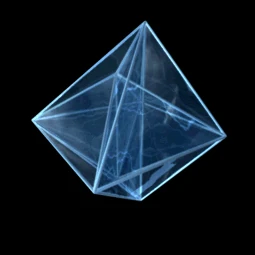
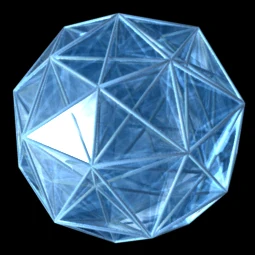
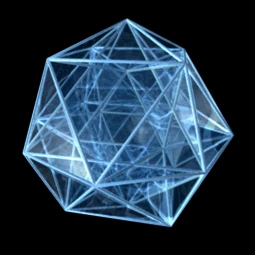
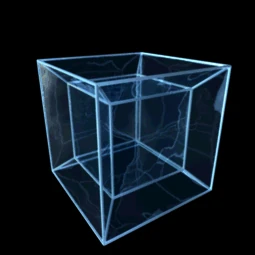
A simplex, cross polytope, or tetraplex (Fig.58) can have two layers — a dipolygon — on every 3-fold face of its exterior and interior tetrahedra. When superimposed with wireframe 3-fold grids, a self-similar 3-fold interference is created on every face of every dipolygonid as the 3-fold 4-dimensional dipolytope rotates through a symmetric multi-dimensional transformation. The same applies for the 3-fold octaplex and its octahedra, the 4-fold tesseract and its cubes, and the 5-fold dodecaplex and its dodecahedra — seen here from an interior view (Fig.58).
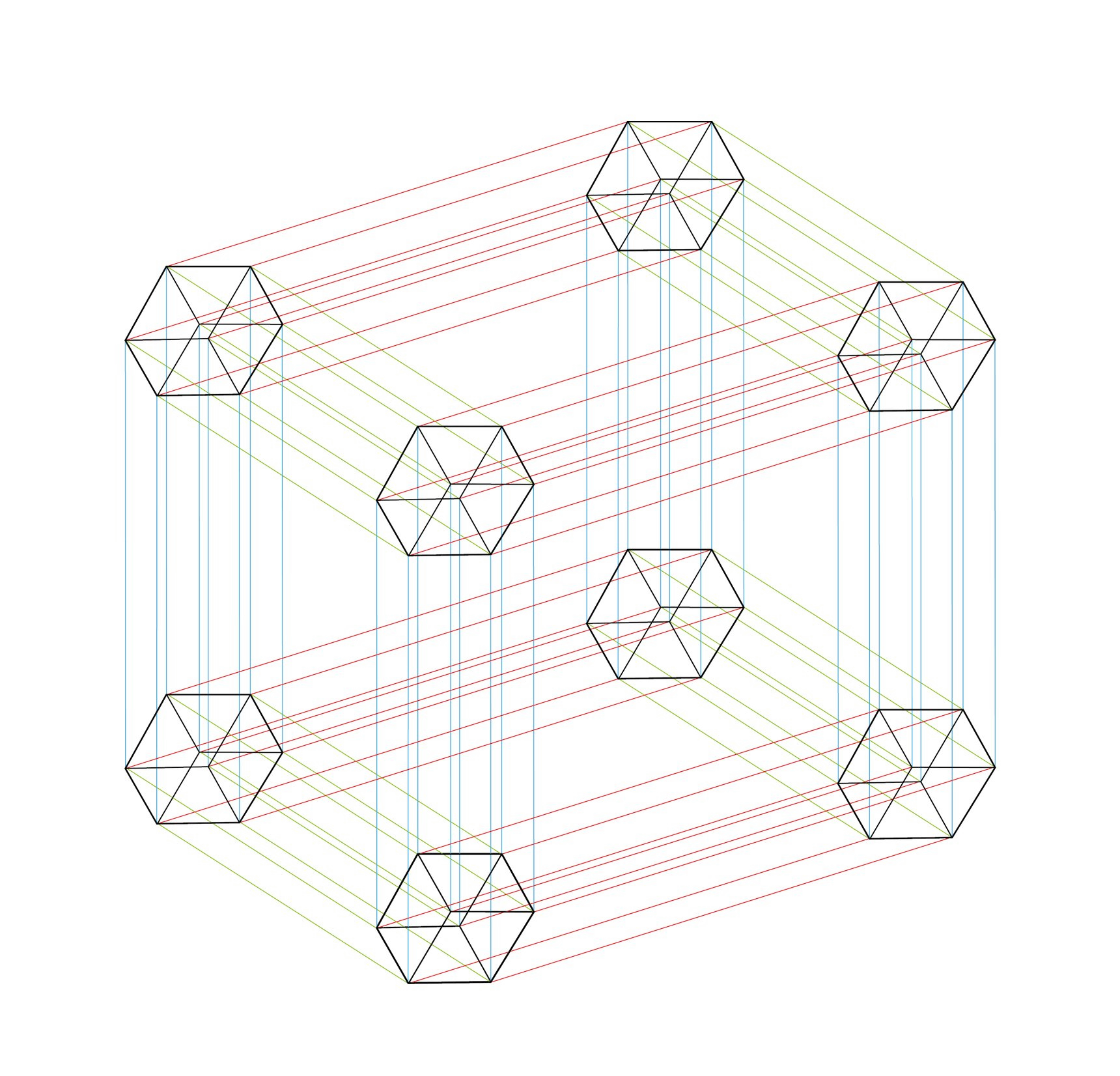
Three of these polytopes — the simplex, cross polytope, and tesseract can have chiral forms in 5-dimensions, and in all higher dimensions as well. Only the tesseract honeycomb creates a valid modular higher-dimensional lattice, though one can also construct 5-dimensional quasi-crystalline arrangements that are chiral.
In each case, the center point O of each face is the centre of each 2-d dipolygon rotation, the spatial center point O of the 3-d chiral structure is the point of invariancy about which the chiral dipolygonid expands and contracts (along the intersection of all dipolygon axes), and these dihedral axes are the tensor-lines of invariancy O — O1, equidistant from every platonic vertex in the 4-d dipolytope transformation about which the polyhedra revolve.
Carlo Séquin points out that one gets a better understanding of polyhedra and polytopes by using wireframe models exclusively. For example, by looking at the convex hull of a 3-dimensional cube, we can infer what is happening on the backside. But by the time one visits a tesseract — a 4-dimensional hypercube — filling in faces with grids and moiré patterns blocks part of the information, making it difficult to visualise. Wireframe models allow one to see into and through to the backside of these objects, and one can use perspective projections to create nested 3-dimensional models.
Now given the concept of combining different shapes that intersect with one-another to form a moiré pattern, rather than having 3-dimensional elements and somehow overlap them, we can go in the other direction and use 1-dimensional elements. We can create higher-dimensional polytopes — intersecting and overlapping in their wireframe mode — rotating against one another. What we’re looking at is the patterns generated by the wireframes of these objects, which would have a moiré-like effect.
Séquin thus observes the simplest 4-dimensional moiré pattern starts out as a 1-dimensional wireframe element. We use two identical elements — polytopes in their wireframe mode — that are perfectly overlapping each other. We start along any one particular axis and rotate the two elements against one another. Some of the edges will split and drift apart to create new interesting patterns. In a sense this is the simplest moiré module for any regular 4-d dipolytope.
If we are to maintain the 3-fold symmetry of the tetrahedron and 3-polygon, we can rotate 3 identical simplexes about a common axis or multiple axes, instead of 2. Thus one can build regular 4- and 5-dimensional interference models for all the 4-d and 5-d polytopes and observe their Boolean intersections and projection moiré patterns.
In the case of the simplex, the axes of rotation are the four axial vertices of a 3-dimensional tetrahedron that remain invariant through the 4-dimensional transformation, and a simplex’s equidistant vertex extruded into an edge-axis in 4-dimensional space remains gravitationally invariant through the 5-dimensional transformation. One continues this reasoning by creating raised, gravitationally locked, and rotationally invariant corners in the n-1 dimensional polytope about which the n-dimensional models symmetrically revolve.
Higher-dimensional kinematics, let alone chiral moiré-polytopes, are difficult to visualise. Perspective projections (Fig.58) are used to show the 6 regular 4-dimensional polytopes, and in Fig.59 we see a stepwise extrusion that leads to an oblique projection of a 6-dimensional measure polytope. This is achieved by sweeping out the edges and vertices of a cube in the 3 higher dimensions, where every edge is a sweep-path of one of its cubes.
Lastly, one can describe platonic polytopes and their 3-dimensional chiral analogues as Fourier transforms and assign eigenvalues to each symmetrical transformation.
XConclusion
The moiré phenomenon, ordinarily confined to the plane, extends faithfully into 3 dimensions. When self-similar grids are carried on the faces of platonic dipolygonids, every transformer in the set produces an interference pattern whose periodicity stands in fixed ratio to its structural rotation — the 2-dimensional moiré and the 3-dimensional rotation-translation share a single clock. This synchronicity holds across the wireframe and alternately checkered families, across the 3-, 4-, and 5-fold symmetries with their periodic and quasi-periodic grids, and persists unchanged when a single cell is multiplied into the octahedra-tetrahedra and cube lattices, or carried through the full 720-degree chiral cycle and its point of invariancy O.
These are buildable kinetics rather than artefacts of rendering. The physical moiré-cell, moiré-box, moiré-diamond, and quasicrystal transformer behave exactly as their digital sequences predict, confirming that the interference is a property of the structure itself — scale-independent, modular, and performing multiple symmetry operations at once.
Several directions remain open. The periodicity ratios observed here invite formal derivation; the description of platonic polytopes and their chiral analogues as Fourier transforms, with eigenvalues assigned to each symmetry operation, remains to be worked out; and the higher-dimensional kinematics of Section IX await direct visualisation — a simplex jitterbugging about its invariant axes in 4 dimensions. I leave these as the natural continuations of this study: regular motions, waiting to be unfolded further.
XIReferences
- Clinton, Joseph D. Advanced Structural Geometry Studies, Part II — A Geometric Transformation Concept for Expanding Rigid Structures. NASA Contractor Report CR-1735, Southern Illinois University, Carbondale. Washington, D.C.: National Aeronautics and Space Administration, September 1971.
- Clinton, Joseph D. “Intersecting Cylinders and the Jitterbug.” Bridges: Mathematical Connections in Art, Music, and Science, Conference Proceedings, Winfield, Kansas, 2004, pp. 345–346.
- Fuller, R. Buckminster. Synergetics: Explorations in the Geometry of Thinking. New York: Macmillan, 1975.
- Gray, Robert W. “Jitterbug Defined Polyhedra: The Shape and Dynamics of Space.” Presentation, Oswego, New York, October 25–26, 2001. rwgrayprojects.com/OswegoOct2001
- Gray, Robert W. “The Jitterbug Motion.” Rochester, New York, September 2002.
- Rossiter, Adrian. Twisters — Antiprism polyhedron album. antiprism.com/album/810_twisters
- Stuart, Duncan R. Polyhedral and Mosaic Transformations. Student Publications of the School of Design, North Carolina State University, Raleigh, 1963.
- Verheyen, H. F. “The Complete Set of Jitterbug Transformers and the Analysis of Their Motion.” Computers & Mathematics with Applications, Vol. 17, No. 1–3, 1989, pp. 203–250.