Advanced Motion Geometries
Think outside what box?
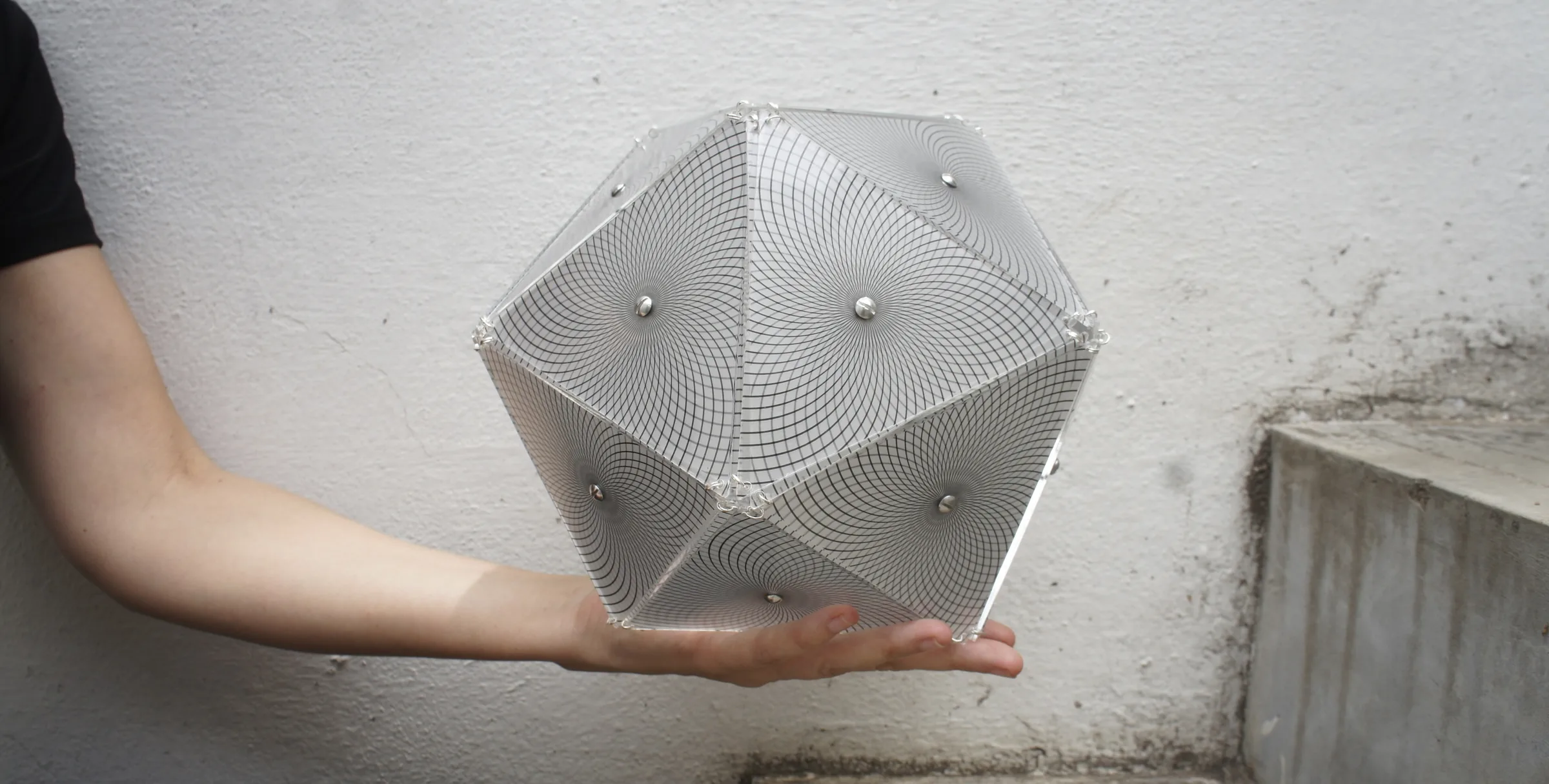
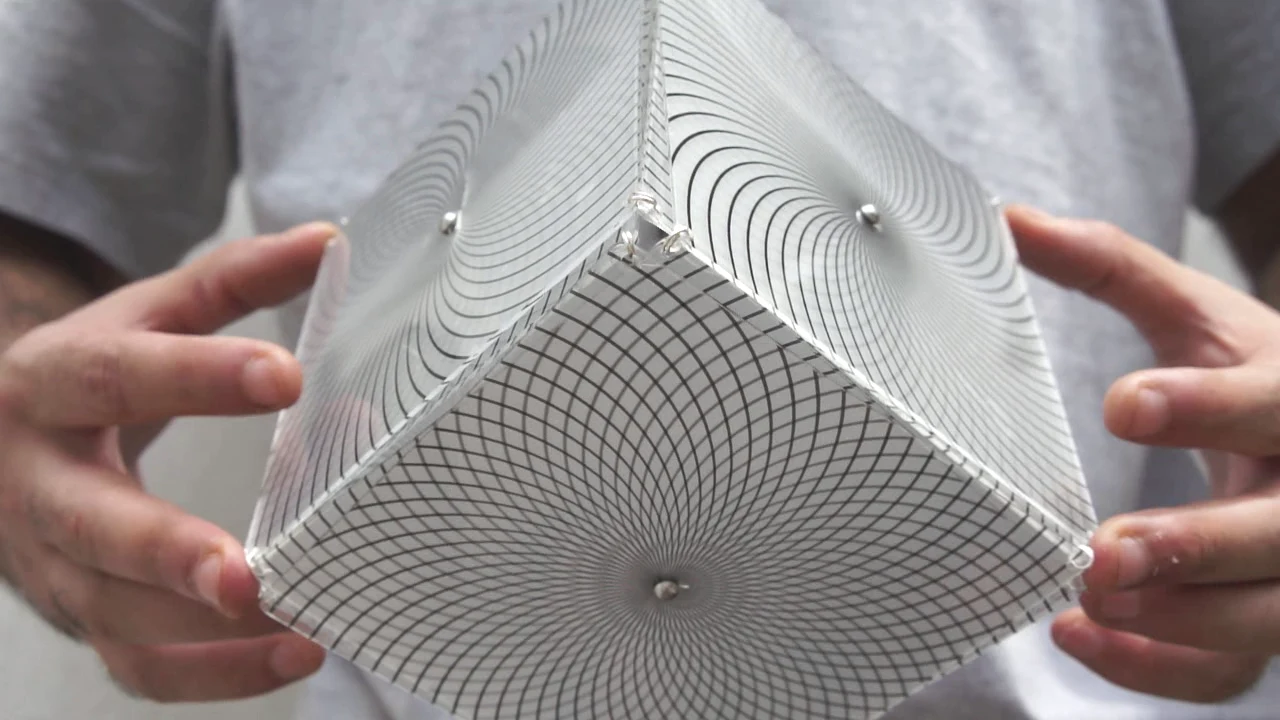
The jitterbug above is a bolted tensegrity. The term ‘tensegrity’ refers to the tensional integrity or interconnected nature of tension and compression that gives the structure its continuous elasticity. Translucent materiality allows for the cube to animate an optical illusion as it expands and contracts. This 4-dimensional object, a spiral hologram, is created by mirrored lines moving in opposing directions, symbolising a physical ‘event-horizon’. It is inspired by the quantum principle of non-locality, i.e. what affects here affects there, from which, everywhere. Strength can be found through rigidity but also by a kinetic ability to sway and adapt.
Each of the works below draws three principles together: the kinetics of a form that expands and contracts, the tensegrity that holds it in balanced tension and compression as it moves, and the interference that emerges when those shifting geometries overlay and read through one another. Where they meet, a newly discovered set of three-dimensional moiré patterns appears — a novel class of multidimensional fractals.
Fuller’s iconic jitterbug inspired design scientists such as Joseph Clinton, Duncan Stuart, and H.F Verheyen to create and classify a family of expanding-contracting structures known as ‘dipolygonids’. These handheld transformers delight through movement; their regularity, symmetry, and binary alternating interconnectivity are fascinating nested alterations to the regular Platonic and Archimedean solids, and their rotational translation embeds them in one another. Kinetic art that requires handheld interaction allows for a more personal, conceptual experience.
These graphic geometrical models build on their work with this in mind. I make original explorations of analog illusion and moving-image techniques on these structures, considering materiality, transparency, and appropriate symbolism; the motion graphics here are inherent in the structures themselves, as opposed to being digital projections. Since dipolygonids require time to expand and contract, they make any concept that takes place through time ripe ground for visualisation — be it lunar and solar cycles, image sequences, or optical patterns — and the viewer’s deliberate action allows the potential animation to actuate. Using radial and grid lines, dots, regular polygons, and cut-out animation, I aim to simulate ideas such as the holographic principle, multidimensionality, synchronicity, converging moiré, quasicrystal, and dot patterns, and the interconnectedness of atomic through universal scales of reality.